

Loading…
Loading…
Loading…
AQA GCSE Combined Science: Synergy · 8465
AQA 8465 · 4.2.1.2 Check the specification (PDF) (opens in a new tab)
Living cells need supplies of substances such as nutrients and, for aerobic respiration, oxygen. They also need to remove waste products such as carbon dioxide. An exchange surface is a surface across which substances enter or leave an organism.
Many substances move by diffusion: the net movement of particles from a higher concentration to a lower concentration. A difference in concentration is called a concentration gradient. Diffusion is effective over short distances, but it is too slow to transport substances over large distances within a body.
A single-celled organism has a relatively large surface area:volume ratio. This means it has a large amount of surface through which substances can pass compared with the volume that needs supplying.
Its small size also means that the distance from the cell surface to the inside of the cell is short. Oxygen can diffuse in across its surface and carbon dioxide can diffuse out quickly enough to meet its needs. It does not need a separate system to carry these gases between distant parts of a body.
Surface area and volume have different roles: the surface provides space for exchange, while the volume represents the amount of living material that needs supplies and produces waste.
As an organism becomes larger, its volume increases faster than its outer surface area. Its surface area:volume ratio therefore decreases. There is less outer surface available for exchange for each unit of living material.
In a large multicellular organism, many cells are also far from the outer surface. Diffusion across that surface alone cannot supply materials and remove waste quickly enough to meet the needs of these internal cells.
Two adaptations work together to solve these problems:
An exchange surface does not replace a transport system. Oxygen first crosses the lung exchange surface by diffusion, is carried around the body in the blood, and then diffuses into the cells that use it.
Multicellular organisms contain specialised cells adapted for particular jobs. Cells with a similar structure and function form a tissue. Different tissues work together in an organ, and groups of organs work together in an organ system.
The organisation can be summarised as:
Specialised cell → tissue → organ → organ system
For example, specialised muscle cells form muscle tissue. Muscle tissue is one of several tissues in the heart. The heart is an organ that works with blood vessels in the circulatory system to transport substances.
The lungs are also organs made of several tissues. Different organ systems cooperate: the respiratory system exchanges gases with the environment, while the circulatory system transports those gases between the lungs and body cells.
A large surface area allows more particles to cross at the same time, increasing the rate of exchange. Numerous alveoli give the lungs a large gas exchange area; villi increase the area available for absorption in the small intestine.
A thin membrane provides a short diffusion path. Particles have only a short distance to travel across the exchange surface, so diffusion is faster.
In animals, an efficient blood supply maintains concentration gradients. At the lungs, blood arriving has a lower oxygen concentration than the air in the alveoli. Oxygen diffuses into the blood, and blood flow carries it away. Fresh blood continues to arrive, preventing oxygen from simply building up beside the exchange surface.
For gaseous exchange in animals, ventilation refreshes the air or water over the surface. In human lungs, breathing brings in fresh air containing oxygen and removes air containing carbon dioxide. Together, ventilation and blood flow maintain the concentration differences that allow oxygen to diffuse into the blood and carbon dioxide to diffuse out.
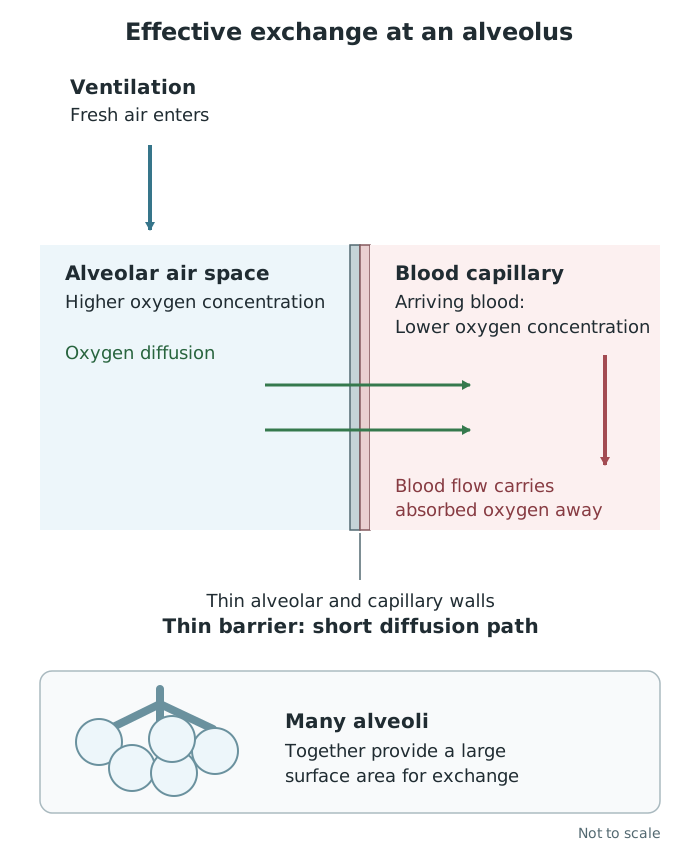
A large area and thin barrier support rapid diffusion; ventilation and blood flow maintain the oxygen concentration gradient.
These adaptations complement one another. A large exchange area would be less useful if the diffusion path were long. Likewise, a large, thin surface would exchange gases more slowly if the concentrations on its two sides became similar.
To calculate a ratio, first find the whole external surface area and the volume. Write surface area:volume, then divide both parts by the volume to express it as .
For a cube with side length :
A cube has six square faces, so all six must be included. For a cube with sides of , the surface area is and the volume is . Its ratio is .
Cubes provide a simple model for comparing size:
| Cube side length / cm | Whole surface area / cm² | Volume / cm³ | Surface area:volume ratio |
|---|---|---|---|
| 1 | 6 | 1 | 6:1 |
| 2 | 24 | 8 | 3:1 |
| 3 | 54 | 27 | 2:1 |
| 4 | 96 | 64 | 1.5:1 |
The larger cubes have more total surface area, but less surface area per unit volume. Doubling the side length multiplies surface area by four and volume by eight, so the ratio halves.
For a cuboid of length , width and height :
Suppose a cuboid has a length of , a width of and a height of . Its surface area is and its volume is . Its ratio is .
This cuboid has the same volume as the cube, but a larger surface area:volume ratio. Shape, as well as size, affects how much surface is available for exchange. These simple shapes model the principle; real organisms are not perfect cubes or cuboids.
Explain both problems in a large organism: less outer surface area per unit volume and longer diffusion distances to internal cells.
A larger organism can have a larger total surface area but a smaller surface area:volume ratio.
Link each adaptation to its effect: a thin membrane shortens the diffusion path; blood flow and ventilation maintain concentration gradients.
Use the same length units throughout a calculation. Calculate surface area and volume separately, then divide both parts of the ratio by the volume.
It can see this note and what your specification asks for.
Answers are free with an account.
1 free note left this week
Get more free notesYour answer sets when this note comes back for review, or marks it complete.
Was this note helpful?
Log in to tell us whether it helped, or to report a problem.
Last updated
Surface area:volume ratio
The total area of an object's surface compared with its volume, calculated as surface area divided by volume and commonly written as .
Diffusion
The net movement of particles from a region of higher concentration to a region of lower concentration.
Concentration gradient
A difference in the concentration of a substance between two regions.
Exchange surface
A surface across which an organism takes in or releases substances.
Transport system
A system that moves substances between exchange surfaces and cells elsewhere in an organism.
Specialised cell
A cell adapted to carry out a particular function.
Tissue
A group of cells with a similar structure and function.
Organ
A structure made of different tissues working together to perform a function.
Organ system
A group of organs working together to perform a particular function.
Ventilation
The movement of fresh air or water over a gas exchange surface.
Put your knowledge into practice — try past paper questions for Combined Science: Synergy
Surface area:volume ratio
The total area of an object's surface compared with its volume, calculated as surface area divided by volume and commonly written as .
Diffusion
The net movement of particles from a region of higher concentration to a region of lower concentration.
Concentration gradient
A difference in the concentration of a substance between two regions.
Exchange surface
A surface across which an organism takes in or releases substances.
Transport system
A system that moves substances between exchange surfaces and cells elsewhere in an organism.
Specialised cell
A cell adapted to carry out a particular function.
Tissue
A group of cells with a similar structure and function.
Organ
A structure made of different tissues working together to perform a function.
Organ system
A group of organs working together to perform a particular function.
Ventilation
The movement of fresh air or water over a gas exchange surface.
Specialised cell → tissue → organ → organ system
An organ contains several tissues. Organs work together in systems, such as the circulatory system.
Cube: , .
Cuboid: , .
For similarly shaped objects, increasing size decreases surface area:volume ratio. Compare ratios using the same length units.