

Loading…
Loading…
Loading…
AQA GCSE Combined Science: Synergy · 8465
AQA 8465 · 4.6.1.4 Check the specification (PDF) (opens in a new tab)
Define weight accurately as the specific force acting on an object entirely due to gravity.
Describe the standardized methods for measuring weight using a calibrated spring balance or newtonmeter.
Describe the mathematical relationship between the weight of a body, its mass, and the local gravitational field strength.
Understand that the force of gravity close to the Earth is caused by the Earth's surrounding gravitational field.
Explain that the weight of an object fundamentally depends on the exact gravitational field strength at its location.
Recall and correctly apply the equation:
Identify the correct units for weight in newtons, mass in kilograms, and gravitational field strength in newtons per kilogram.
Recognize and apply the principle that the weight of an object is directly proportional to its mass.
Use the mathematical symbol for proportionality correctly within physics contexts.
A bag of flour labelled 2 kg has a mass of 2 kg. Mass is a measure of the amount of matter in an object. Weight, however, is the force acting on an object due to gravity. Like other forces, weight is measured in newtons (N), not kilograms.
Moving the same bag from Earth to the Moon would not change the amount of matter it contains, so its mass would remain 2 kg. Its weight would become smaller because the Moon's gravitational field is weaker.
A gravitational field is a region where a mass experiences a gravitational force. Earth has a gravitational field around it, so an object near Earth experiences a pull towards Earth's centre. This is the object's weight. Gravity acts without Earth needing to touch the object.
Gravitational field strength, , tells us the force acting on each kilogram of mass at a particular location. Its unit is newtons per kilogram (N/kg). For example, a field strength of 10 N/kg means that each kilogram of mass experiences a gravitational force of 10 N.
The same object has a greater weight where the gravitational field is stronger and a smaller weight where it is weaker. Weight therefore depends on both the object's mass and the gravitational field strength at its location.
These quantities are linked by:
Here, is weight in N, is mass in kg, and is gravitational field strength in . In calculations, the value of will be given.
Suppose a parcel has a mass of 3 kg and the gravitational field strength is 10 N/kg. Its weight is . This means gravity pulls on the parcel with a force of 30 N.
You can rearrange the equation to find either of the other quantities:
For example, an object weighing 20 N in a field of 10 N/kg has a mass of .
At a constant gravitational field strength, weight is directly proportional to mass:
The symbol means 'is directly proportional to'. Doubling the mass doubles the weight; tripling the mass triples the weight. The ratio stays constant because it equals .
The graph below shows calculated weights for a field strength of 10 N/kg.
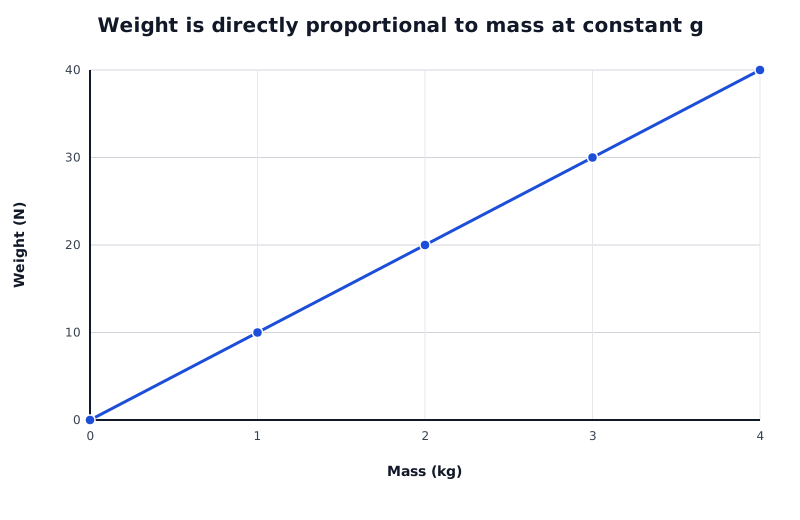
Calculated weights for a constant gravitational field strength of 10 N/kg. Doubling the mass doubles the weight.
Data for Weight is directly proportional to mass at constant g
| Series | Mass (kg) | Weight (N) |
|---|---|---|
| g = 10 N/kg | 0 | 0 |
| g = 10 N/kg | 1 | 10 |
| g = 10 N/kg | 2 | 20 |
| g = 10 N/kg | 3 | 30 |
| g = 10 N/kg | 4 | 40 |
A graph of weight against mass is a straight line through the origin. Each additional kilogram adds the same amount of weight. A stronger gravitational field would produce a steeper line because each kilogram would experience a larger force.
Weight is measured using a calibrated spring balance, also called a newtonmeter. An object hanging from its hook pulls on a spring and stretches it. The calibrated scale is marked in newtons, allowing the force to be read directly.
Choose a newtonmeter whose range is suitable for the object. Check that it reads zero with nothing attached, then hold or support it vertically and hang the object securely from the hook. Wait until the object and pointer are still, then read the scale at eye level.
Do not exceed the instrument's maximum force, and keep your feet clear of the hanging object in case it falls. A steady reading gives the object's weight at that location.
Use the value of gravitational field strength given in the question; AQA supplies it in calculations.
Convert mass from grams to kilograms before using W = mg: divide by 1000.
Give weight in newtons, not kilograms.
When stating that weight is directly proportional to mass, specify that gravitational field strength is constant.
It can see this note and what your specification asks for.
Answers are free with an account.
1 free note left this week
Get more free notesYour answer sets when this note comes back for review, or marks it complete.
Was this note helpful?
Log in to tell us whether it helped, or to report a problem.
Last updated
Mass
A measure of the amount of matter in an object, measured in kilograms (kg). Moving an unchanged object to a different gravitational field does not change its mass.
Weight
The force acting on an object due to gravity, measured in newtons (N).
Gravitational field
A region around a mass where another mass experiences a gravitational force.
Gravitational field strength
The gravitational force per kilogram of mass at a particular location, represented by and measured in newtons per kilogram (N/kg).
Newtonmeter
A calibrated spring balance used to measure force, including weight, in newtons.
Direct proportionality
A relationship in which two quantities change in the same ratio, so their quotient is constant. For constant gravitational field strength, .
Put your knowledge into practice — try past paper questions for Combined Science: Synergy
Mass
A measure of the amount of matter in an object, measured in kilograms (kg). Moving an unchanged object to a different gravitational field does not change its mass.
Weight
The force acting on an object due to gravity, measured in newtons (N).
Gravitational field
A region around a mass where another mass experiences a gravitational force.
Gravitational field strength
The gravitational force per kilogram of mass at a particular location, represented by and measured in newtons per kilogram (N/kg).
Newtonmeter
A calibrated spring balance used to measure force, including weight, in newtons.
Direct proportionality
A relationship in which two quantities change in the same ratio, so their quotient is constant. For constant gravitational field strength, .
: N; : kg; : N/kg.
For constant , : doubling mass doubles weight. A weight–mass graph is a straight line through the origin.
Use a calibrated spring balance (newtonmeter). Check zero, hang the object vertically, wait for a steady reading and read the scale in newtons.