

Loading…
Loading…
Loading…
AQA GCSE Combined Science: Synergy · 8465
AQA 8465 · 4.4.2.2 Check the specification (PDF) (opens in a new tab)
Describe the crucial roles of interdependence and competition within a biological community.
Explain how organisms require a continuous supply of materials from their surroundings and from other living organisms to survive and reproduce.
Identify the resources that plants typically compete for, including light, space, water, and mineral nutrients from the soil.
Identify the resources that animals commonly compete for, including food, mates, and territory.
Explain the concept of interdependence, where species rely on each other for food, shelter, pollination, and seed dispersal.
Predict the cascading effects on a whole community if a single species is removed from the ecosystem.
Define a stable community as one where all species and environmental factors are in balance, resulting in fairly constant population sizes.
A community consists of the populations of different species living and interacting in the same area. Organisms in a community do not live independently: they obtain materials from their surroundings and from other living organisms.
Plants take up water and mineral nutrients from the soil and use light for photosynthesis. Photosynthesis produces glucose, which provides material for growth and can be used in respiration to release energy. Animals obtain food by eating plants or other animals. Food supplies both materials for building their bodies and energy for processes such as movement, growth and reproduction.
These needs create two important relationships: competition, when organisms need the same limited resource, and interdependence, when species rely on one another.
Competition occurs when a resource is limited: there is not enough for every organism to obtain as much as it needs. It can occur between members of the same species or between different species.
Plants commonly compete for light, space, water and mineral nutrients from the soil. Each resource has a different role:
Imagine seedlings growing close together. As their leaves and roots spread, they increasingly draw on the same resources. A seedling that gains more light or water may grow more successfully than its neighbours. Competition therefore affects which plants survive and reproduce, and can influence the sizes of their populations.
Animals commonly compete for food, mates and territory.
Food supplies energy and materials for growth and reproduction. When food is scarce, some animals may obtain too little to survive or produce offspring. Animals competing for the same food do not have to fight: one may simply eat food before another can reach it.
Competition for mates affects opportunities to reproduce and pass on genes. This competition is generally between members of the same species.
A territory is an area occupied and defended by an animal. It can contain food, water, shelter or access to mates. Gaining a territory can therefore secure several resources at once; losing it can reduce an animal's chances of survival or reproduction.
Interdependence means that species depend on other species within their community. Feeding relationships are one example, but the connections extend beyond food:
Competition and interdependence can exist together. Two animals may compete for the same plant food while both depend on those plants for survival. Similarly, plants may compete for light while relying on animals for pollination or seed dispersal.
Because species are connected, removing one can cause changes that spread through a community. The first effect may be on a species directly dependent on it, followed by effects on other species further along the chain of dependence.
For example, consider flowering plants that depend mainly on bees for pollination. If those bees disappear, fewer flowers may be pollinated, so fewer seeds are produced. Over time, the plant population may fall. Herbivores that depend on those plants then have less food, so their populations may decline. Predators feeding on those herbivores may also decline.
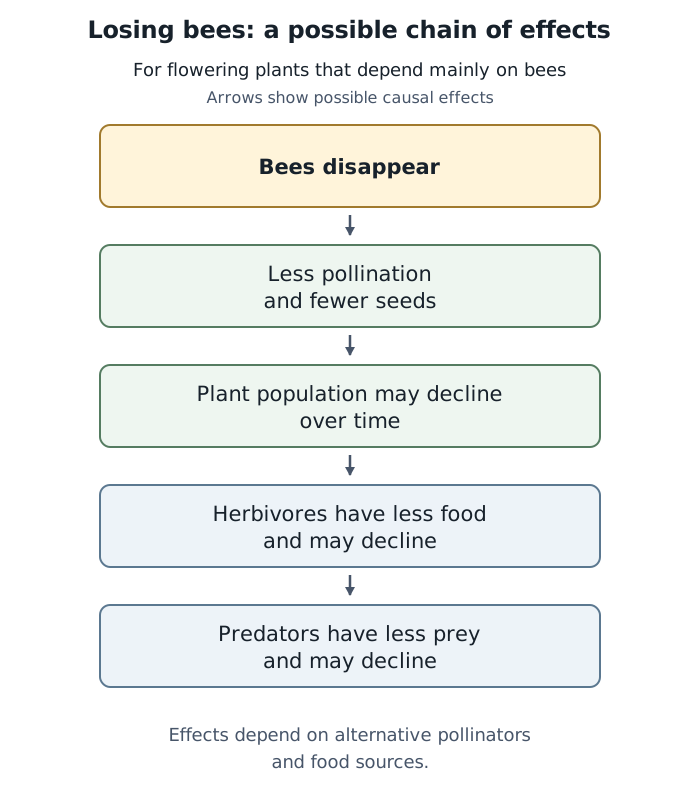
A change in one species can spread through several linked populations.
This is a possible chain of effects, rather than an inevitable outcome for every plant. Plants pollinated by wind or by other animals would not be affected in the same way. Likewise, a consumer with alternative food sources may be less affected than one that depends on a single food source. To predict a change, follow the actual dependencies in the community rather than assuming that every population changes in the same direction.
A stable community is one in which all the species and environmental factors are in balance, so population sizes remain fairly constant.
Stability does not mean that organisms stop competing, feeding or reproducing. These processes continue, and populations can fluctuate, but there are no large, lasting changes in their sizes. Removing a species or disrupting an important resource can upset this balance because many organisms depend on the same network of relationships.
Species depend on one another for food, shelter, pollination and seed dispersal. Organisms also need materials from their non-living surroundings.
Removing a species can affect the whole community. Trace the dependencies: loss of a pollinator → reduced plant reproduction → less food for herbivores → less prey for predators. Outcomes depend on alternative resources and relationships.
For competition, name the limited resource and explain how reduced access affects survival, growth or reproduction.
Plants compete for light, space, water and mineral nutrients; animals commonly compete for food, mates and territory.
When predicting a community change, explain each link: which species loses a resource, how its population may change, and what happens to species that depend on it.
A stable community has fairly constant population sizes, not identical numbers of every species or populations that never fluctuate.
It can see this note and what your specification asks for.
Answers are free with an account.
1 free note left this week
Get more free notesYour answer sets when this note comes back for review, or marks it complete.
Was this note helpful?
Log in to tell us whether it helped, or to report a problem.
Last updated
Community
All the populations of different species living and interacting in the same area.
Population
The individuals of one species living in the same area at the same time.
Competition
The interaction between organisms that need the same limited resource.
Interdependence
The dependence of species on other species within a community for resources or services such as food, shelter, pollination and seed dispersal.
Territory
An area occupied and defended by an animal that can provide access to resources such as food, shelter and mates.
Stable community
A community in which species and environmental factors are in balance, so population sizes remain fairly constant.
Put your knowledge into practice — try past paper questions for Combined Science: Synergy
Community
All the populations of different species living and interacting in the same area.
Population
The individuals of one species living in the same area at the same time.
Competition
The interaction between organisms that need the same limited resource.
Interdependence
The dependence of species on other species within a community for resources or services such as food, shelter, pollination and seed dispersal.
Territory
An area occupied and defended by an animal that can provide access to resources such as food, shelter and mates.
Stable community
A community in which species and environmental factors are in balance, so population sizes remain fairly constant.
In a stable community, species and environmental factors are in balance, so population sizes remain fairly constant. Some fluctuation is compatible with stability.