

Loading…
Loading…
Loading…
AQA GCSE Combined Science: Synergy · 8465
AQA 8465 · 4.1.3.3 Check the specification (PDF) (opens in a new tab)
Cells need substances from their surroundings and must remove waste products. Their cell membranes control what can enter and leave. Three processes move substances across these membranes: diffusion, osmosis and active transport.
To understand the direction of movement, first consider concentration: the amount of a substance in a given volume. A solution containing more sugar in the same volume has a higher sugar concentration. A difference in concentration between two regions is a concentration gradient.
Particles in liquids and gases are constantly moving randomly. Diffusion is their spreading out and mixing, resulting in net movement from higher to lower concentration, down a concentration gradient. Some substances can cross cell membranes this way.
Imagine more oxygen molecules outside a cell than inside it. Molecules move in both directions, but more enter than leave. This overall difference is the net movement. As the concentrations become equal, there is no net movement, although individual molecules continue moving.
Diffusion is passive: the cell does not need to supply energy from respiration. For example, oxygen diffuses from the air in the lungs into the blood, while carbon dioxide diffuses from the blood into the lungs to be breathed out.
Three factors affect the rate of diffusion across a membrane. When comparing them, assume the other conditions stay the same.
Surface area concerns how much membrane is available for exchange, rather than how fast an individual particle moves.
A solute is a dissolved substance, such as salt or sugar. A dilute solution has relatively little solute and a higher concentration of water. A more concentrated solution has more solute and a lower concentration of water.
Osmosis is the net movement of water molecules from a dilute solution to a more concentrated solution through a partially permeable membrane. Water therefore moves down its own concentration gradient.
Cell membranes are partially permeable: they allow small molecules such as water through but prevent larger molecules from passing. In an osmosis model, the membrane allows water to cross while retaining the dissolved solute. Like diffusion, osmosis does not require energy from respiration.
If the solution around plant tissue is more dilute than the solution inside its cells, water enters by osmosis and the tissue gains mass. If the surrounding solution is more concentrated, water leaves and the tissue loses mass. When the solutions are balanced, water still crosses both ways, but there is no net movement and no mass change due to osmosis.
Diffusion cannot produce net movement of a substance from lower to higher concentration. Cells can achieve this using active transport, which requires energy transferred from respiration.
Plant root hair cells absorb mineral ions from very dilute soil solutions. The mineral ion concentration can already be higher inside the cells than in the soil. Active transport allows further uptake against the concentration gradient, supplying minerals needed for healthy growth. This is different from the uptake of water, which occurs by osmosis.
Active transport also allows sugar molecules to be absorbed from the human gut into the blood when the sugar concentration in the gut is lower than that in the blood. Absorption can therefore continue when diffusion alone would not move sugar into the blood.
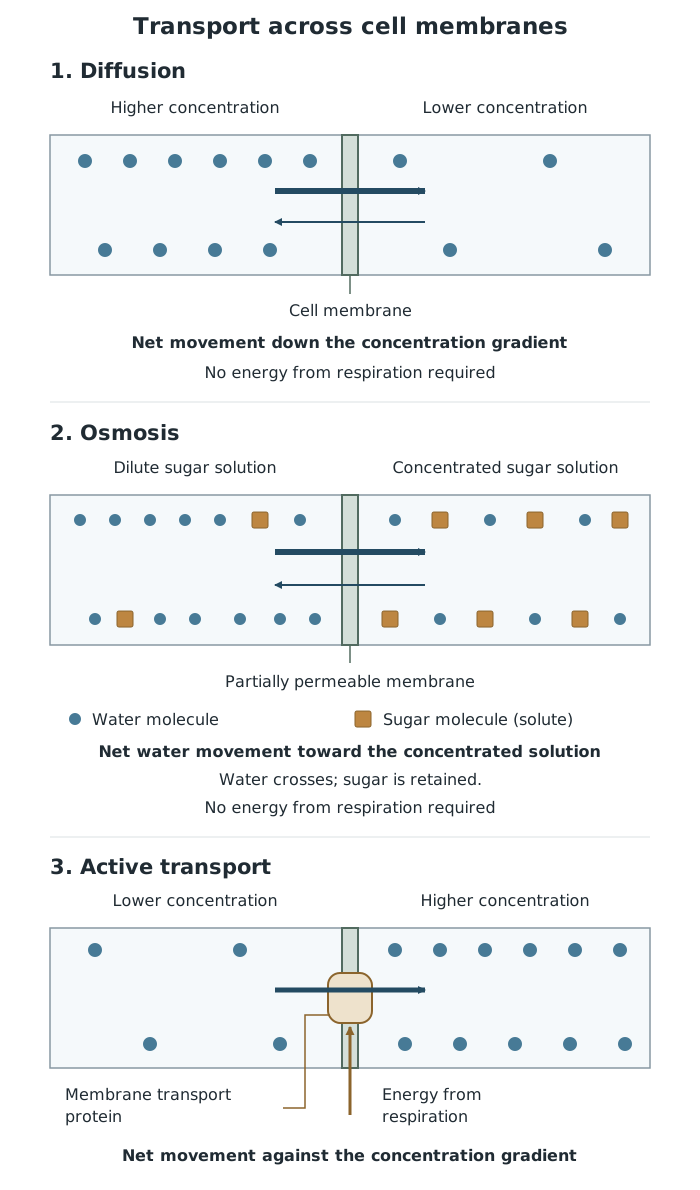
Compare the transported substance, the direction of net movement and whether energy from respiration is required.
The key distinction is direction relative to the gradient: diffusion moves particles down it, osmosis moves water down its water concentration gradient, and active transport moves a dissolved substance against it.
The investigation tests how a range of salt or sugar solution concentrations affects the mass of plant tissue. Potato cylinders are suitable because they can be cut to similar dimensions and weighed before and after soaking.
You need potato tissue, a cork borer, a cutting tile and knife or scalpel, a ruler, a balance, labelled containers, a measuring cylinder, paper towels, a timer and a range of known salt or sugar solution concentrations. Use one solute throughout the investigation and include water as the zero-concentration solution.
Use cutting tools on a cutting tile and cut away from fingers under teacher supervision. Do not eat the tissue or taste the solutions, and wipe up spills promptly.
The independent variable is solution concentration. The dependent variable is the change in tissue mass, usually expressed as a percentage. Keep tissue dimensions and source, solution volume, soaking time and temperature constant. These controls make it more likely that differences in mass change are caused by concentration.
The measurement period ends after the chosen soaking time; it does not require a visible colour change or complete cessation of osmosis. Mass measurements reveal whether there has been a net gain or loss of water. Blotting is important because liquid clinging to a cylinder would otherwise be weighed with the tissue.
First calculate the change in mass:
Then express it relative to the starting mass:
For example, suppose a potato cylinder initially has a mass of 2.00 g and has a final mass of 2.20 g after soaking. Its percentage change is . This positive value indicates a net gain of water. A negative percentage change indicates a net loss.
Percentage change allows fairer comparisons between samples with slightly different initial masses. Calculate it for each cylinder before finding the mean at each concentration: add the percentage changes and divide by the number of cylinders.
Repeats also show how variable the results are. Record the minimum and maximum percentage changes at each concentration. A wide range suggests more uncertainty in the mean than a narrow range. Investigate any unusual result rather than automatically discarding it. Consistent blotting, equal dimensions and precise mass measurements help reduce uncertainty.
Put solution concentration on the horizontal axis and mean percentage change in mass on the vertical axis. Label both axes with units, use evenly spaced scales and include positive and negative percentage changes. Plot the points and draw a suitable line or curve of best fit through the overall trend, rather than forcing it through every point. You can show the spread of repeats with vertical range bars from the minimum to the maximum result.
Suppose a set of potato samples produces the pattern below.
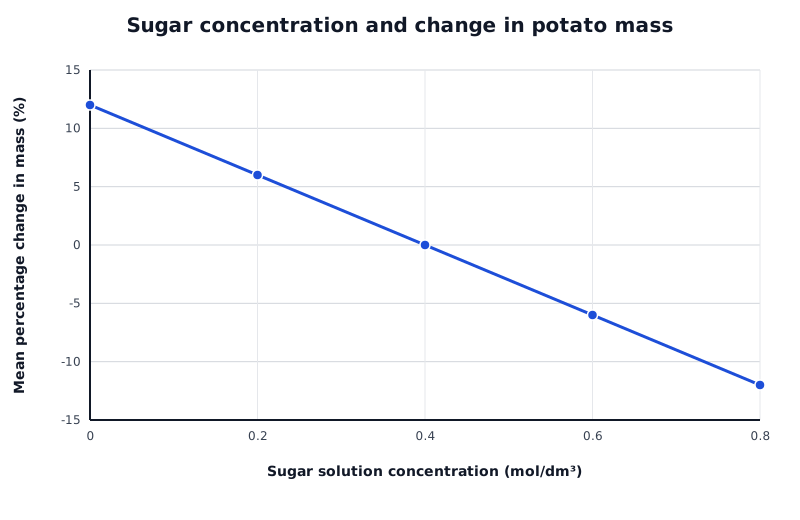
A constructed example: mass gain decreases as sugar concentration rises. The zero crossing estimates the concentration giving no net water movement.
Data for Sugar concentration and change in potato mass
| Series | Sugar solution concentration (mol/dm³) | Mean percentage change in mass (%) |
|---|---|---|
| Mean percentage change in potato mass | 0 | 12 |
| Mean percentage change in potato mass | 0.2 | 6 |
| Mean percentage change in potato mass | 0.4 | 0 |
| Mean percentage change in potato mass | 0.6 | -6 |
| Mean percentage change in potato mass | 0.8 | -12 |
Points above zero represent mass gain: water entered the tissue by osmosis. Points below zero represent mass loss: water left the tissue. The concentration where the best-fit line crosses zero estimates the solution concentration at which there is no net water movement into or out of the tissue. In this constructed example, that concentration is 0.40 mol/dm³.
Estimate a crossing between measured points by reading from the line to the concentration axis. If all results are above zero or all are below zero, the tested range has not located the crossing: further concentrations would be needed. Greater scatter makes the estimated crossing less certain.
| Process | Net movement | Energy from respiration? |
|---|---|---|
| Diffusion | Particles: higher → lower concentration | No |
| Osmosis | Water: dilute → more concentrated solution, through a partially permeable membrane |
For diffusion and osmosis, describe the net movement: particles still move in both directions.
In an osmosis answer, name water, the partially permeable membrane and the direction of movement. Distinguish water concentration from solute concentration.
Active transport requires energy from respiration; water uptake into root hair cells is by osmosis, not active transport.
Calculate percentage change using the initial mass as the denominator. Keep a negative sign for a loss of mass.
Blot potato samples before weighing: solution left on the surface would affect the measured mass.
The zero-change point on an osmosis graph indicates no net movement of water, not that water molecules have stopped moving.
It can see this note and what your specification asks for.
Answers are free with an account.
1 free note left this week
Get more free notesYour answer sets when this note comes back for review, or marks it complete.
Was this note helpful?
Log in to tell us whether it helped, or to report a problem.
Last updated
Concentration
The amount of a substance in a given volume.
Concentration gradient
A difference in the concentration of a substance between two regions.
Diffusion
The spreading out and mixing of particles through their random movement, resulting in net movement from higher to lower concentration.
Osmosis
The net movement of water molecules from a dilute solution to a more concentrated solution through a partially permeable membrane.
Partially permeable membrane
A membrane that allows some substances, such as water molecules, to pass through but prevents others from passing.
Solute
A substance dissolved in a solvent to form a solution; for example, sugar dissolved in water.
Active transport
The movement of a dissolved substance across a cell membrane from lower to higher concentration, requiring energy from respiration.
Percentage change
The change in a measurement expressed as a percentage of its initial value. For mass, .
Put your knowledge into practice — try past paper questions for Combined Science: Synergy
Concentration
The amount of a substance in a given volume.
Concentration gradient
A difference in the concentration of a substance between two regions.
Diffusion
The spreading out and mixing of particles through their random movement, resulting in net movement from higher to lower concentration.
Osmosis
The net movement of water molecules from a dilute solution to a more concentrated solution through a partially permeable membrane.
Partially permeable membrane
A membrane that allows some substances, such as water molecules, to pass through but prevents others from passing.
Solute
A substance dissolved in a solvent to form a solution; for example, sugar dissolved in water.
Active transport
The movement of a dissolved substance across a cell membrane from lower to higher concentration, requiring energy from respiration.
Percentage change
The change in a measurement expressed as a percentage of its initial value. For mass, .
| No |
| Active transport | Dissolved substance: lower → higher concentration | Yes |
Faster diffusion: greater concentration difference, higher temperature, larger membrane surface area.
Active transport examples: mineral ions from dilute soil solutions into root hair cells; sugar from a lower concentration in the gut into blood with a higher concentration.
Horizontal axis: solution concentration. Vertical axis: mean percentage change in mass (%).