

Loading…
Loading…
Loading…
AQA GCSE Combined Science: Synergy · 8465
AQA 8465 · 4.5.1.1 Atomic Number and Periodic Table Check the specification (PDF) (opens in a new tab)
Explain how an element's precise position in the periodic table relates to the arrangement of its electrons and its atomic number.
Describe the structure of the periodic table, noting that elements are arranged in order of increasing atomic number so that elements with similar properties form vertical columns called groups.
Understand that the table is described as periodic because similar chemical properties occur at regular intervals.
Explain that electrons occupy specific energy levels (shells), systematically filling the lowest available energy levels first.
Identify that elements in the same group possess the same number of electrons in their outermost shell, which directly dictates their similar chemical properties.
Represent the electronic structure of the first 20 elements using numerical notation.
Predict the possible reactions and probable reactivity of different elements based entirely on their position in the periodic table.
Explain how the discovery of isotopes forced a critical change in Mendeleev's original periodic table arrangement.
Describe how Mendeleev initially arranged elements by relative atomic mass, which resulted in some elements appearing in inappropriate groups.
Understand how arranging elements by atomic number resolved Mendeleev's inconsistencies, recognizing that most elements occur as a mixture of isotopes.
Demonstrate an understanding of how scientific methods and structural theories have evolved over time.
The periodic table arranges elements in order of increasing atomic number. Atomic number is the number of protons in an atom's nucleus, so each element has its own atomic number. Lithium has atomic number 3; sodium has atomic number 11.
A neutral atom has equal numbers of positively charged protons and negatively charged electrons. Its atomic number therefore also tells you how many electrons it has. A neutral sodium atom has 11 protons and 11 electrons.
Those electrons are not all at the same energy level. Their arrangement explains why an element belongs in a particular row and column of the periodic table—and why it reacts in a particular way.
Electrons occupy particular energy levels, also called shells, around the nucleus. They occupy the lowest available energy levels first: the innermost available shells fill before electrons occupy higher energy levels.
For the first 20 elements, use this filling pattern:
This is the shell model needed here; it is not a rule that every shell can hold only eight electrons.
Electronic structure means the arrangement of electrons in these shells. In numerical notation, write the number in each occupied shell, starting with the innermost, and separate the numbers with commas.
For example, sodium's 11 electrons are arranged as two in the first shell, eight in the second and one in the third. Its electronic structure is 2,8,1. The numbers add up to 11, and each number represents a shell—not an individual electron.
Calcium has atomic number 20. After placing two electrons in the first shell, eight in the second and eight in the third, two remain for the fourth shell. Its electronic structure is 2,8,8,2.
The same method gives the electronic structure of every neutral atom in this table.
| Element | Symbol | Atomic number | Electronic structure |
|---|---|---|---|
| Hydrogen | H | 1 | 1 |
| Helium | He | 2 | 2 |
| Lithium | Li | 3 | 2,1 |
| Beryllium | Be | 4 | 2,2 |
| Boron | B | 5 | 2,3 |
| Carbon | C | 6 | 2,4 |
| Nitrogen | N | 7 | 2,5 |
| Oxygen | O | 8 | 2,6 |
| Fluorine | F | 9 | 2,7 |
| Neon | Ne | 10 | 2,8 |
| Sodium | Na | 11 | 2,8,1 |
| Magnesium | Mg | 12 | 2,8,2 |
| Aluminium | Al | 13 | 2,8,3 |
| Silicon | Si | 14 | 2,8,4 |
| Phosphorus | P | 15 | 2,8,5 |
| Sulfur | S | 16 | 2,8,6 |
| Chlorine | Cl | 17 | 2,8,7 |
| Argon | Ar | 18 | 2,8,8 |
| Potassium | K | 19 | 2,8,8,1 |
| Calcium | Ca | 20 | 2,8,8,2 |
The horizontal rows of the periodic table are called periods. The period number tells you the number of occupied shells. Sodium, 2,8,1, has three occupied shells, so it is in Period 3. Potassium, 2,8,8,1, has four, so it is in Period 4.
The vertical columns are called groups. Using the GCSE group numbering 1–7 and 0, the group number for Groups 1–7 matches the number of outer-shell electrons. Chlorine, 2,8,7, has seven outer electrons, placing it in Group 7. Its three occupied shells also place it in Period 3.
Group 0 contains the noble gases, whose outer shells are full. Neon, 2,8, and argon, 2,8,8, each have eight outer electrons. Helium has only two, but its first shell is full with two electrons, so it also belongs in Group 0.
Hydrogen has one outer electron and is often shown above Group 1, but it is a non-metal, not an alkali metal. Its properties differ from those of lithium, sodium and potassium.
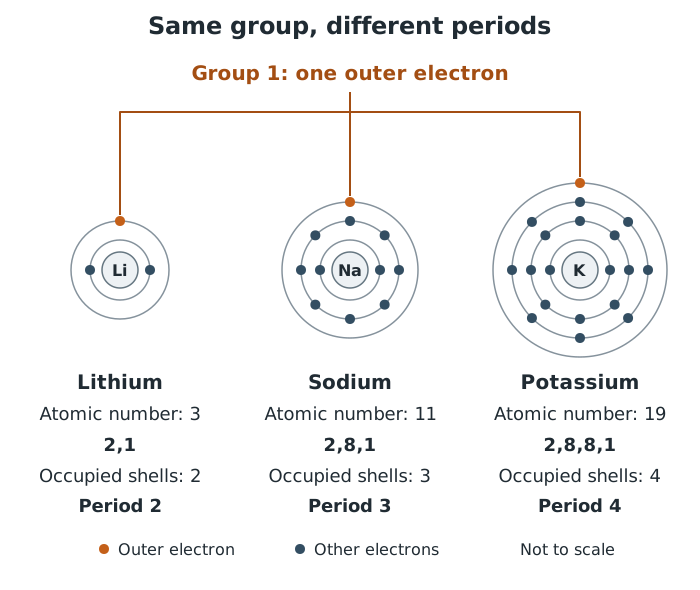
Lithium, sodium and potassium share one outer electron, but have increasing numbers of occupied shells.
Lithium, sodium and potassium have different total numbers of electrons and occupied shells, yet each has one outer electron. That shared outer-shell arrangement is the connection between their positions in the same column.
An atom's outer electrons determine how it takes part in chemical reactions. Elements with the same number of outer electrons therefore have similar chemical properties.
Moving across Period 2, the outer shell builds up from one electron in lithium to eight in neon. Sodium then starts a new occupied shell with one electron. Its outer-shell arrangement resembles lithium's, so its chemical behaviour also resembles lithium's. Potassium repeats this pattern in the next period.
This recurrence of similar properties is why the table is called periodic. Arranging elements by atomic number reveals a repeating pattern of outer-electron arrangements, and elements with similar properties line up in groups.
The periodic table lets you make reasoned predictions, rather than treating every element as an unrelated substance. Its broad pattern also separates metals, mainly on the left and towards the bottom, from non-metals, mainly towards the upper right.
Group 1: the alkali metals. Lithium, sodium and potassium each have one outer electron, which they lose in reactions. All react with water to form hydrogen and a metal hydroxide. Sodium, for example, forms hydrogen and sodium hydroxide. Their shared group position helps predict the same type of reaction.
They are not equally reactive: reactivity increases down Group 1, so potassium reacts more vigorously with water than sodium, and sodium more vigorously than lithium. Down the group there are more occupied shells. The outer electron is farther from the nucleus and more shielded by inner electrons, so it is less strongly attracted and easier to remove.
Group 7: the halogens. These non-metals have seven outer electrons and can gain one electron to complete their outer shell. They react with metals to form metal halides; sodium and chlorine, for example, form sodium chloride.
Here, reactivity decreases down the group. An incoming electron is attracted less strongly as the outer shell becomes farther from the nucleus and shielding increases. Chlorine is therefore more reactive than bromine or iodine.
This allows a specific prediction: chlorine will displace bromine from potassium bromide solution, forming potassium chloride and bromine. Bromine will not displace chlorine from potassium chloride solution because bromine is less reactive.
Group 0: the noble gases. Their full outer shells make them stable and very unreactive. Neon, 2,8, and argon, 2,8,8, are therefore unlikely to react under ordinary conditions.
Group position predicts similarities in reactions; position within a group helps predict differences in reactivity. The link running through both is the arrangement of electrons.
For a neutral atom, the numbers in its electronic structure must add up to its atomic number. Do not use the mass number to count electrons.
Count the occupied shells to find the period; use the outer-shell electrons to identify the group.
Group 0 does not mean zero outer electrons. Its atoms have full outer shells: two electrons for helium and eight for neon and argon.
For the first 20 elements, potassium is 2,8,8,1 and calcium is 2,8,8,2.
When predicting reactivity, name the group before applying a trend: reactivity increases down Group 1 but decreases down Group 7.
It can see this note and what your specification asks for.
Answers are free with an account.
1 free note left this week
Get more free notesYour answer sets when this note comes back for review, or marks it complete.
Was this note helpful?
Log in to tell us whether it helped, or to report a problem.
Last updated
Atomic number
The number of protons in an atom's nucleus. In a neutral atom, it also equals the number of electrons.
Electron shell
An energy level occupied by electrons around an atom's nucleus.
Electronic structure
The arrangement of electrons in an atom's shells, which can be written as numbers separated by commas, such as 2,8,1.
Group
A vertical column of the periodic table containing elements with similar chemical properties.
Period
A horizontal row of the periodic table. Its number equals the number of occupied electron shells in an atom of an element in that row.
Outer electron
An electron in the outermost occupied shell of an atom. Outer electrons determine how an atom takes part in chemical reactions.
Periodicity
A repeating pattern. In the periodic table, similar chemical properties recur as atomic number increases.
Displacement reaction
A reaction in which a more reactive element replaces a less reactive element in a compound.
Put your knowledge into practice — try past paper questions for Combined Science: Synergy
Atomic number
The number of protons in an atom's nucleus. In a neutral atom, it also equals the number of electrons.
Electron shell
An energy level occupied by electrons around an atom's nucleus.
Electronic structure
The arrangement of electrons in an atom's shells, which can be written as numbers separated by commas, such as 2,8,1.
Group
A vertical column of the periodic table containing elements with similar chemical properties.
Period
A horizontal row of the periodic table. Its number equals the number of occupied electron shells in an atom of an element in that row.
Outer electron
An electron in the outermost occupied shell of an atom. Outer electrons determine how an atom takes part in chemical reactions.
Periodicity
A repeating pattern. In the periodic table, similar chemical properties recur as atomic number increases.
Displacement reaction
A reaction in which a more reactive element replaces a less reactive element in a compound.
| Group | Outer shell | Behaviour | Reactivity down group |
|---|---|---|---|
| 1: alkali metals | One electron | Lose one electron; react with water to form hydrogen and a metal hydroxide | Increases: outer electron is easier to remove |
| 7: halogens | Seven electrons | Gain one electron; react with metals to form metal halides | Decreases: attraction for an incoming electron weakens |
| 0: noble gases | Full | Very unreactive under ordinary conditions | Full outer shell explains their stability |
A more reactive halogen displaces a less reactive halogen from a solution of its salt.