Loading…


Loading…
Loading…
Loading…
AQA GCSE Combined Science Trilogy · 8464
AQA 8464 · 6.6.2.4 Check the specification (PDF) (opens in a new tab)
Electromagnetic waves can carry both energy and information. Their applications depend on how they interact with the atmosphere, materials and living tissue. A wave that passes through a material can carry a signal through it; a wave that is absorbed transfers energy to that material.
All students need to know the applications below. The explanations labelled Higher Tier show why the waves are suitable.
Radio waves carry television and radio broadcasts. A transmitter sends waves carrying information, and a receiving aerial detects them so that the information can be turned into pictures or sound.
Higher Tier: some radio waves can be reflected back towards Earth by a region of the upper atmosphere. This allows them to reach receivers beyond the horizon, making them useful for long-range broadcasting. Not all radio broadcasts follow this route.
Microwaves are used for satellite communications. Signals travel from a ground station to a satellite, which can relay them to another ground station.
Higher Tier: microwaves can pass through Earth's atmosphere, so they can travel between the ground and a satellite rather than being reflected back towards Earth.
Microwaves are also used to cook food in microwave ovens.
Higher Tier: water in food absorbs microwaves strongly. Energy is transferred to the food, raising its temperature. The microwaves used for communication are not intended to produce this substantial heating effect.
Infrared radiation is used in electrical heaters and in cooking, such as grilling. The hot heating element emits infrared radiation, which transfers energy to the objects or food around it.
Higher Tier: when the food or another object absorbs infrared radiation, its internal energy increases and its temperature can rise. This makes infrared useful when the aim is heating rather than transmitting information.
Infrared cameras detect infrared radiation rather than relying on visible light. They produce thermal images that reveal temperature differences. For example, they can help locate a person in darkness.
Higher Tier: warm objects emit infrared radiation. An infrared camera detects this emission and represents differences using shades or colours. Those displayed colours are a way of showing the infrared information; they are not necessarily the objects' actual visible colours.
Visible light can carry information through fibre optic cables. Light signals travel along thin transparent fibres, allowing information to be sent from one end to the other.
Higher Tier: light can undergo total internal reflection at the fibre's boundary. Instead of escaping through the sides, it is repeatedly reflected back into the fibre and guided along it. This allows the signal to follow the cable's route.
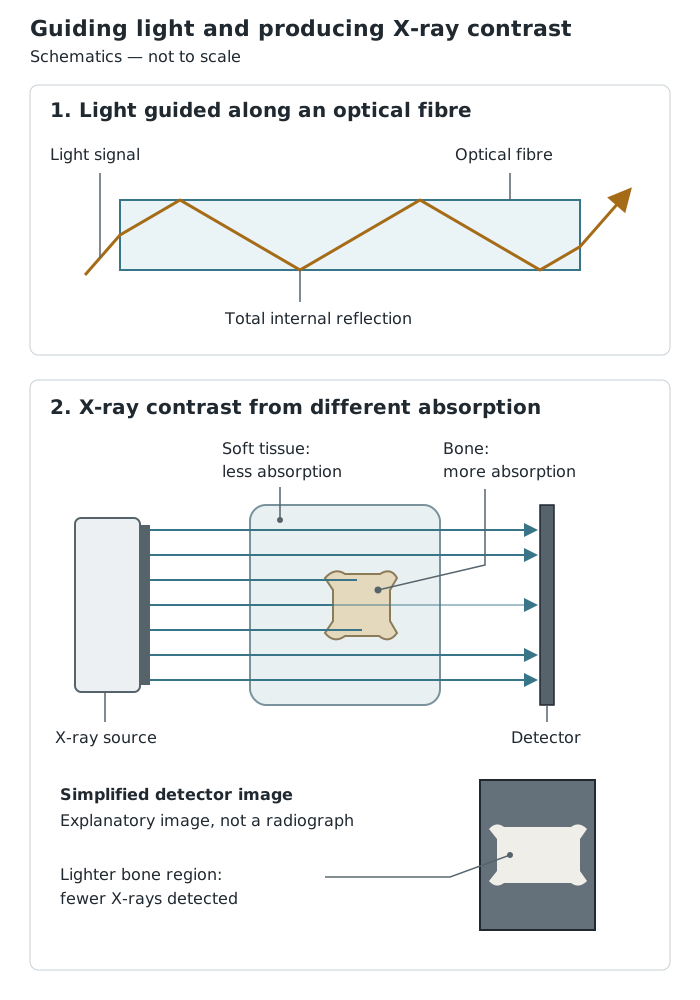
Light is guided along an optical fibre by internal reflection. X-ray images rely on bone absorbing more radiation than surrounding soft tissue.
Ultraviolet radiation is used in energy-efficient fluorescent lamps. Ultraviolet produced inside the lamp is absorbed by a fluorescent coating, which emits visible light. This conversion is called fluorescence.
Higher Tier: ultraviolet is suitable because it makes the coating fluoresce, producing the visible light needed for illumination. The useful output of the lamp is visible light, not ultraviolet.
Ultraviolet also causes sun tanning. Exposure stimulates the skin to produce more protective pigment, making it darker.
Higher Tier: ultraviolet produces this response in the skin, which is why it is used in tanning equipment. A tan does not mean that exposure is harmless: ultraviolet can damage skin and increase skin cancer risk.
X-rays are used for medical imaging, particularly to examine bones. An X-ray detector records the radiation that passes through the body.
Higher Tier: X-rays pass through soft tissue more readily than through bone. Bone absorbs more of the radiation, so fewer X-rays reach the detector behind it. This difference produces contrast in the image and allows a fracture to be seen.
Gamma rays are used to treat cancer. Radiation is directed at the cancerous tissue to kill cancer cells.
Higher Tier: gamma rays can penetrate into the body and damage or kill cells. Their cell-killing effect makes them useful for treatment, but healthy tissue must also be protected as far as possible. The useful effect here is destroying cells, whereas the useful effect in X-ray imaging is producing an image from differences in absorption.
Get unlimited access to all revision notes, key terms, and exam tips.
| Wave | Applications |
|---|---|
| Radio | Television and radio broadcasts |
| Microwave | Satellite communications; cooking food |
| Infrared | Electrical heaters; cooking food; infrared cameras |
| Visible light | Fibre optic communications |
| Ultraviolet | Energy-efficient fluorescent lamps; sun tanning |
| X-ray | Medical imaging, especially bones |
| Gamma ray | Cancer treatment |
Get unlimited access to all revision notes, key terms, and exam tips.
For a use question, name a specific application rather than writing only ‘communication’ or ‘medicine’.
For Higher Tier explanations, link a property to its purpose: for example, microwaves pass through the atmosphere, allowing signals to travel to and from satellites.
For X-ray imaging, explain the difference in absorption: bone absorbs more X-rays than soft tissue. Do not say that all X-rays pass through everything.
Distinguish the two cooking applications: microwave ovens use microwaves, while grills transfer energy to food by infrared radiation.
Electromagnetic wave
A wave that transfers energy through oscillating electric and magnetic fields and can travel through a vacuum.
Transmission
The passage of radiation through a material.
Absorption
The transfer of energy from radiation to the material it encounters.
Total internal reflection
The complete reflection of light back into a material at its boundary, under suitable conditions. It keeps light travelling along an optical fibre.
Fluorescence
The absorption of radiation followed by the emission of light; for example, a fluorescent coating absorbs ultraviolet and emits visible light.
Thermal imaging
Producing an image from infrared radiation emitted by objects, revealing differences in their temperature.
Put your knowledge into practice — try past paper questions for Combined Science Trilogy
Electromagnetic wave
A wave that transfers energy through oscillating electric and magnetic fields and can travel through a vacuum.
Transmission
The passage of radiation through a material.
Absorption
The transfer of energy from radiation to the material it encounters.
Total internal reflection
The complete reflection of light back into a material at its boundary, under suitable conditions. It keeps light travelling along an optical fibre.
Fluorescence
The absorption of radiation followed by the emission of light; for example, a fluorescent coating absorbs ultraviolet and emits visible light.
Thermal imaging
Producing an image from infrared radiation emitted by objects, revealing differences in their temperature.