Loading…


Loading…
Loading…
Loading…
AQA GCSE Combined Science Trilogy · 8464
AQA 8464 · 5.6.1.3 Check the specification (PDF) (opens in a new tab)
A reaction rate describes how quickly reactants are used up or products are formed. To explain why conditions change this speed, we need to consider the reacting particles: atoms, molecules or ions.
According to collision theory, reacting particles must collide with each other for a reaction to occur. However, a collision alone is not enough. The particles must also have sufficient energy. The minimum amount of energy they must have to react is called the activation energy.
A collision that produces a reaction is a successful collision. Collisions with insufficient energy do not produce a reaction. The rate therefore depends on the number of successful collisions per second. Conditions can increase this by making collisions more frequent, by increasing the proportion with sufficient energy, or by doing both.
A more concentrated solution contains more dissolved reactant particles in a given volume. With more reacting particles in the same space, collisions between reactants become more frequent.
For example, magnesium reacts faster with a more concentrated acid, provided the other conditions are unchanged. More acid particles are available to collide with the magnesium surface each second. At the same temperature, the proportion of collisions with sufficient energy is unchanged, but the greater collision frequency means more successful collisions per second.
Diluting the acid has the opposite effect: fewer acid particles per unit volume lead to less frequent collisions and a slower reaction.
For reacting gases, increasing pressure by compressing them into a smaller volume brings the particles closer together. The number of particles has not increased, but there are now more particles per unit volume.
At constant temperature, this makes collisions more frequent without making the particles more energetic. More successful collisions occur per second, so the reaction rate increases. Reducing the pressure by allowing the gases to occupy a larger volume has the opposite effect.
Concentration and gas pressure therefore have a similar explanation: both can increase the number of reacting particles in a given volume.
When a solid reacts with a solution or gas, collisions occur at its exposed surface. Particles inside a large lump are not initially accessible to the other reactant.
Breaking the same mass of solid into smaller pieces exposes more surface without changing the total volume of solid. Smaller pieces have a larger surface area to volume ratio. More solid particles are available for collisions, so successful collisions occur more frequently and the reaction is faster.
For example, powdered calcium carbonate reacts faster with acid than the same mass of large marble chips, when the acid and temperature are otherwise unchanged.
A cube shows why cutting matters. One cube with sides of 2 cm has a volume of 8 cm³ and a surface area of 24 cm². Cutting it into eight separate cubes with sides of 1 cm leaves the total volume at 8 cm³, but increases the total exposed surface area to 48 cm². The surface area per unit volume has doubled because previously internal surfaces are now exposed.
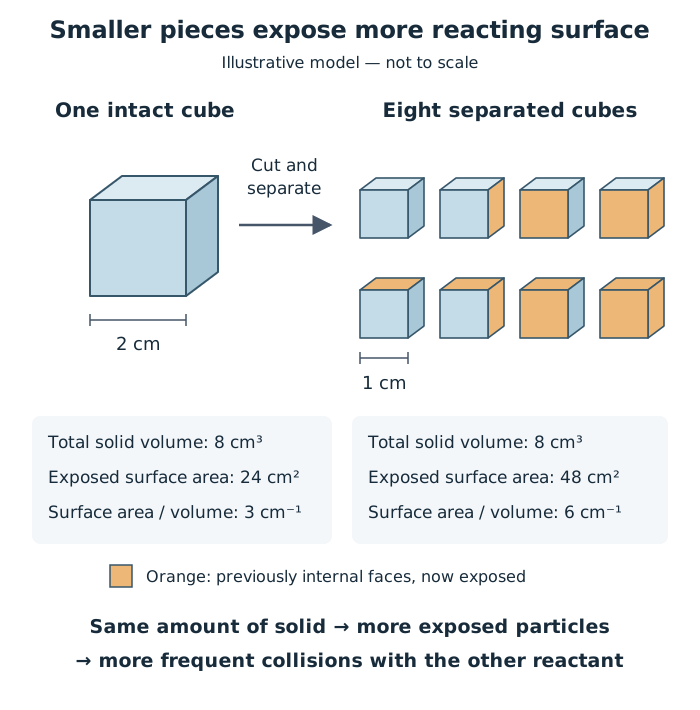
Cutting and separating the same solid exposes new surfaces. Its total volume stays the same, but its surface area to volume ratio increases.
The smaller cubes must be separated so that the other reactant can reach their new surfaces. This model explains why a powder generally reacts faster than lumps of the same solid.
Heating gives particles more kinetic energy. They move faster, so they collide more frequently.
There is also a second important effect. Particles do not all have the same energy. At a higher temperature, a greater proportion of collisions have energy at least equal to the activation energy. A larger fraction of collisions is therefore successful.
Together, these effects produce more successful collisions per second and a faster reaction. Cooling reverses both effects: particles move more slowly, collisions are less frequent, and a smaller proportion have sufficient energy to react.
The activation energy itself does not fall when the reaction mixture is heated. Heating changes the particles’ energies, not the energy threshold they must reach.
In a simple collision model, doubling the concentration of one reactant while keeping the other conditions unchanged can approximately double its collision frequency with the other reactant. If the fraction of successful collisions stays the same, the reaction rate approximately doubles too.
For this model:
Direct proportionality means that halving the concentration halves the predicted rate, while tripling it triples the predicted rate. The explanation must still link the concentration change to particles per unit volume and then to successful collisions per second.
This is not a universal rule for every reaction. Use it when the question or data supports the simple relationship. In particular, temperature does not have this simple proportional effect: it changes both collision frequency and the proportion of collisions that are successful.
Get unlimited access to all revision notes, key terms, and exam tips.
Reacting particles must collide with sufficient energy to react.
Activation energy: the minimum energy particles must have to react.
Faster reaction = more successful collisions per second.
Decreasing these factors has the opposite effect. Heating does not lower activation energy.
Where the simple model applies:
Doubling concentration approximately doubles rate if other conditions are unchanged. Do not apply this relationship automatically to every reaction or to temperature.
Get unlimited access to all revision notes, key terms, and exam tips.
Explain a rate change using collisions per second or the frequency of successful collisions, not just the total number of collisions.
For temperature, include both effects: more frequent collisions and a greater proportion of collisions with energy at least equal to the activation energy.
For smaller solid pieces, link a larger surface area to volume ratio to more exposed particles and more frequent collisions.
Do not claim that increasing concentration, pressure or surface area makes particles more energetic. Compare these factors at the same temperature.
Use direct proportionality only where the question or a simple model supports it; doubling a factor does not always double the reaction rate.
Collision theory
An explanation of reaction rates based on how frequently reacting particles collide and whether their collisions have sufficient energy to cause a reaction.
Activation energy
The minimum amount of energy that reacting particles must have to react.
Successful collision
A collision between reacting particles that results in a chemical reaction.
Collision frequency
The number of collisions occurring per unit time, such as per second.
Concentration
The amount of a dissolved substance in a given volume of solution.
Surface area to volume ratio
The surface area of an object divided by its volume. Smaller pieces of the same shape have a larger surface area to volume ratio.
Direct proportionality
A relationship in which multiplying one quantity by a factor multiplies the other by the same factor, written .
Put your knowledge into practice — try past paper questions for Combined Science Trilogy
Collision theory
An explanation of reaction rates based on how frequently reacting particles collide and whether their collisions have sufficient energy to cause a reaction.
Activation energy
The minimum amount of energy that reacting particles must have to react.
Successful collision
A collision between reacting particles that results in a chemical reaction.
Collision frequency
The number of collisions occurring per unit time, such as per second.
Concentration
The amount of a dissolved substance in a given volume of solution.
Surface area to volume ratio
The surface area of an object divided by its volume. Smaller pieces of the same shape have a larger surface area to volume ratio.
Direct proportionality
A relationship in which multiplying one quantity by a factor multiplies the other by the same factor, written .