Loading…


Loading…
Loading…
Loading…
AQA GCSE Combined Science Trilogy · 8464
AQA 8464 · 6.5.4.2.2 Newton's Second Law Check the specification (PDF) (opens in a new tab)
Required Practical 19 investigates two relationships: how acceleration changes when force changes at constant mass, and how acceleration changes when mass changes at constant force. Acceleration means the rate of change of velocity, not simply how fast an object moves.
Newton’s Second Law predicts:
Here, is the resultant force in newtons (N), is mass in kilograms (kg), and is acceleration in metres per second squared (m/s²). Testing one relationship at a time lets us distinguish the effect of force from the effect of mass.
Use a toy car or trolley, a metre ruler, chalk, a stopwatch, string, a bench pulley, a mass hanger and small slotted masses. Clamps and stands support the apparatus where needed, and Blu-Tac secures added masses to the car. Use a balance to measure the moving masses.
Mark equally spaced lines across the bench, for example every 0.20 m over a distance of 1.0 m. Attach the pulley securely at the far end. Tie the string to the car, pass it over the pulley and attach the hanger to its other end. Keep the string horizontal and aligned with the car.
The weight of the hanging masses provides the driving force. As the hanger falls, the car moves towards the pulley. Both accelerate, so the relevant moving mass includes the car, the hanger and all added masses. Friction opposes the motion; the resultant force on this moving system is therefore less than the hanging weight.
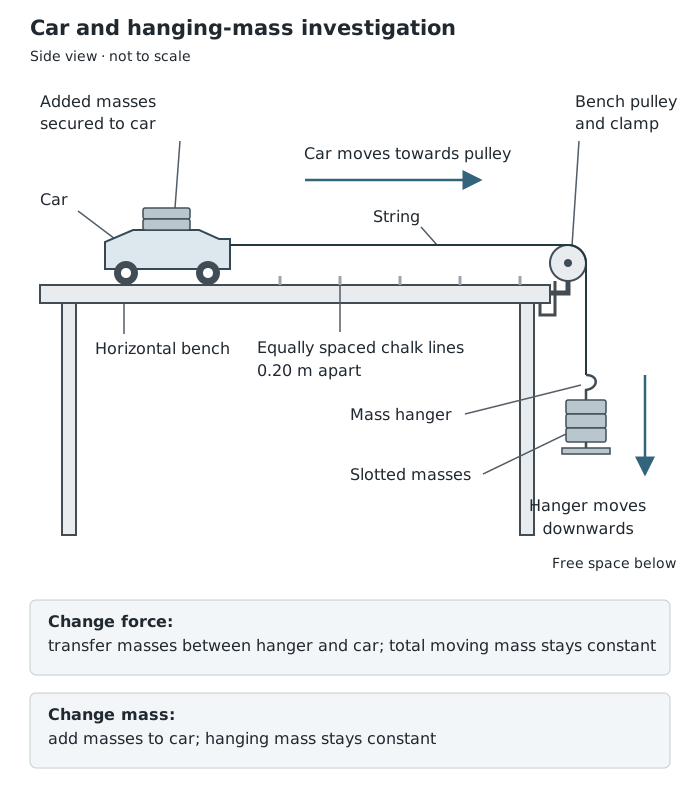
The hanger’s weight drives the motion. Transfer masses to change force at constant total mass; add masses to the car to change mass at constant driving force.
Choose a hanging weight that gently accelerates the car, leaving enough time to record its motion. Ensure the hanger can descend freely without reaching the floor during the measurements. Keep feet clear of falling masses, secure the pulley and stop the car before it reaches the bench edge.
Release the car from the same starting position without pushing it. Start the stopwatch on release and record the elapsed time at each marked line, using lap timing. Repeat each condition several times and calculate mean elapsed times for the lines.
Subtract successive elapsed times to find the time spent in each distance interval. Calculate the average speed over each interval:
For example, if equal distances take progressively shorter times, the car’s speed is increasing. One average speed for the entire journey would hide this change.
Because the car travels in one direction, these speeds can be used to estimate its change in velocity. Treat each interval’s average speed as an estimate of its speed at the midpoint in time of that interval. Compare an early and a later interval, then calculate:
Here, and are the earlier and later estimated speeds, and is the time between their interval midpoints. This gives an estimate of acceleration from the motion measurements.
The independent variable is the driving force; the dependent variable is acceleration. Keep the total moving mass constant.
Begin with masses on the hanger, then reduce the hanging weight in steps. A small weight stack could provide 1.0 N, reduced in steps of 0.2 N. Every mass removed from the hanger must be transferred to the car and secured. This changes the driving force without changing how much total mass must accelerate.
For each force, repeat the release and timing procedure and calculate acceleration. Keep the bench surface, starting position, distance intervals and release method unchanged.
Plot acceleration on the vertical axis against driving force on the horizontal axis. Acceleration should increase as force increases. Ideally, acceleration is directly proportional to the resultant force at constant mass. Friction can make a graph against hanging weight depart from a straight line through the origin.
Now keep the hanging mass unchanged and add different masses to the car. The independent variable is total moving mass; acceleration is again the dependent variable. Include the hanger and its masses when calculating each total.
Repeat the same motion measurements for each mass. Keeping the hanging weight unchanged keeps the driving force constant; use the same bench and apparatus to keep friction as similar as possible.
Acceleration should decrease as total mass increases. Ideally, at constant resultant force, doubling the mass halves the acceleration: . An acceleration–mass graph is therefore a decreasing curve, not a straight descending line.
Short travel times make stopwatch reaction time a substantial source of error. Gentle acceleration makes timing easier, while repeating measurements and taking means reduces the effect of random variation.
Videoing the car and marked lines allows crossing times to be read from the recording, reducing reliance on human reaction time. Friction remains a limitation: repeats do not remove a persistent opposing force. Interpret the results as a test of the predicted trends while recognising that hanging weight is not necessarily equal to resultant force.
Get unlimited access to all revision notes, key terms, and exam tips.
Use the time between the midpoints of the intervals used to estimate and .
| Investigation | Change | Keep constant | Expected relationship |
|---|---|---|---|
| Force and acceleration | Hanging weight | Total moving mass: transfer masses between hanger and car | |
| Mass and acceleration | Add masses to car | Hanging weight |
Total moving mass includes the car, hanger and added masses.
Get unlimited access to all revision notes, key terms, and exam tips.
For the force investigation, keep the total moving mass constant, not just the mass of the car: transfer masses between the hanger and the car.
For the mass investigation, keep the hanging mass unchanged so that the driving force stays constant.
A journey time alone is not an acceleration. Explain how you obtain speeds and then calculate change in velocity divided by the time between those speeds.
Describe a specific improvement and its benefit: video reduces reliance on stopwatch reaction time; repeats and means reduce the effect of random timing errors.
Acceleration
The rate of change of velocity, measured in metres per second squared (m/s²).
Resultant force
The single force that has the same effect as all the forces acting together on an object.
Independent variable
The factor deliberately changed during an investigation.
Dependent variable
The factor measured or calculated to find the effect of changing the independent variable.
Control variable
A factor kept unchanged so that its effect does not interfere with the relationship being investigated.
Put your knowledge into practice — try past paper questions for Combined Science Trilogy
Acceleration
The rate of change of velocity, measured in metres per second squared (m/s²).
Resultant force
The single force that has the same effect as all the forces acting together on an object.
Independent variable
The factor deliberately changed during an investigation.
Dependent variable
The factor measured or calculated to find the effect of changing the independent variable.
Control variable
A factor kept unchanged so that its effect does not interfere with the relationship being investigated.