Loading…


Loading…
Loading…
Loading…
AQA GCSE Combined Science Trilogy · 8464
AQA 8464 · 6.5.3 Elasticity and Spring Extension Check the specification (PDF) (opens in a new tab)
Forces can change an object's shape as well as its motion. This change in shape is called deformation. Pulling opposite ends of a spring stretches it; pushing its ends towards each other compresses it. To bend a ruler, you can support its ends and push down in the middle: the downward force and upward support forces act at different positions, making the ruler bend.
Changing the shape of a stationary object requires more than one force. If you pull one end of a spring while holding the other, your pull acts at one end and your holding hand provides an opposing force at the other. In a hanging-spring experiment, the load pulls down and the support pulls up. The forces balance once the spring is stationary, but they act on different parts of it and can change its shape. A single unbalanced force would make the object accelerate rather than remain stationary.
A spring stretched gently usually returns to its original length when the load is removed. This is elastic deformation: the change in shape is reversible.
If the spring is stretched too far, it may remain longer after the load is removed. This is inelastic deformation: there is a permanent change in shape. The distinction depends on what happens after unloading, not simply on how much the object stretches.
Extension is the increase in length, not the whole length of the stretched object:
Here, is the loaded length and is the original unloaded length. For example, a spring whose length changes from 8 cm to 11 cm has an extension of 3 cm, or 0.03 m.
Within a spring's proportional region, doubling the applied force doubles its extension. This relationship is called Hooke's law:
is force in newtons (N), is the spring constant in newtons per metre (N/m), and is extension in metres (m). A larger spring constant means a stiffer spring: more force is needed for the same extension.
The equation can be rearranged to find either unknown:
For example, a spring extending by 0.03 m under a force of 6 N has . For this spring, a 4 N force would produce an extension of , provided it remains in the proportional region. Conversely, an extension of 0.01 m would require .
The same relationship applies to compression of an elastic object. In that case, is the amount by which its length decreases, measured in metres.
A graph with force on the vertical axis and extension on the horizontal axis shows direct proportionality as a straight line through the origin. Equal increases in force produce equal increases in extension. Beyond the limit of proportionality, the graph curves: the relationship becomes non-linear and a single constant spring constant no longer describes it.
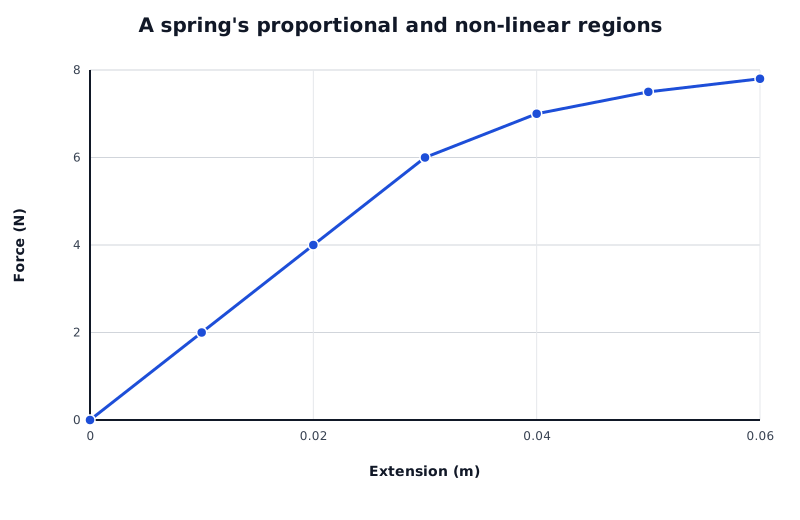
Force and extension are proportional up to 0.03 m and 6 N; the relationship then becomes non-linear.
Data for A spring's proportional and non-linear regions
| Series | Extension (m) | Force (N) |
|---|---|---|
| Illustrative spring loading | 0 | 0 |
| Illustrative spring loading | 0.01 | 2 |
| Illustrative spring loading | 0.02 | 4 |
| Illustrative spring loading | 0.03 | 6 |
| Illustrative spring loading | 0.04 | 7 |
| Illustrative spring loading | 0.05 | 7.5 |
| Illustrative spring loading | 0.06 | 7.8 |
The graph is straight up to an extension of 0.03 m and a force of 6 N. Beyond that point, its gradient changes. This identifies the limit of proportionality in this example. A curved loading graph alone does not tell you whether the deformation is permanent; that requires checking what happens when the force is removed.
In the straight-line region, the gradient gives the spring constant:
The symbol means 'change in'. Using the points (0.01 m, 2 N) and (0.03 m, 6 N), the gradient is . A steeper force-against-extension line represents a stiffer spring.
The aim is to investigate how changing the applied force affects a spring's extension. A suitable method uses a spring suspended from a clamp stand, a mass hanger and slotted masses, and a vertical ruler beside a pointer attached near the spring's lower end.
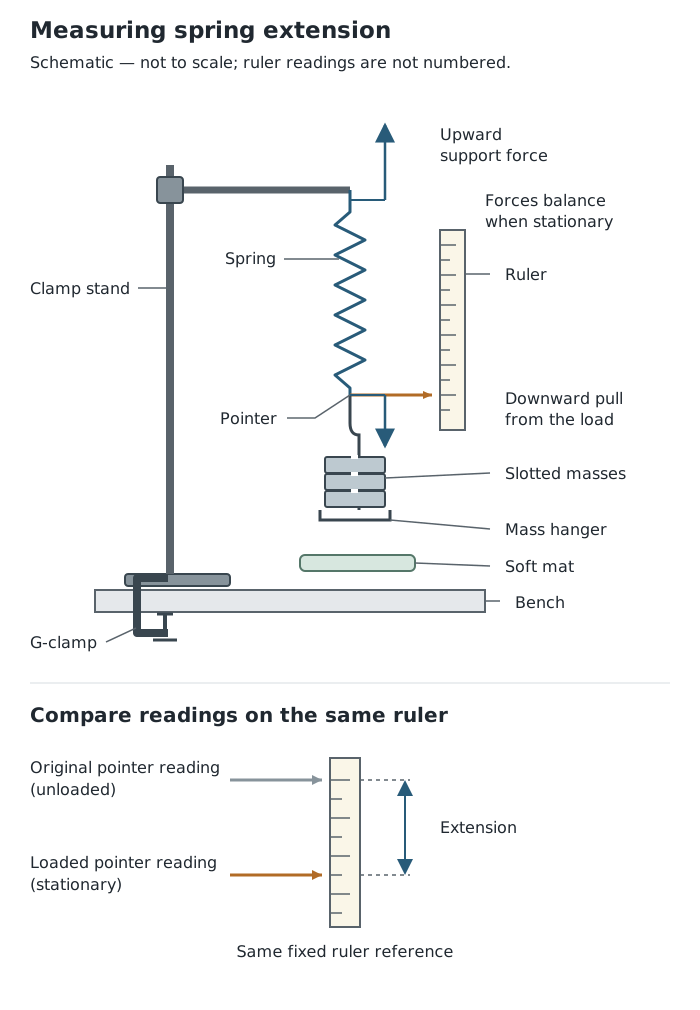
The change in the pointer's reading gives extension. The hanging load provides the downward force, while the clamp supports the spring.
The independent variable is the applied force; the dependent variable is extension. Use the same spring throughout so that you are investigating its response rather than comparing different springs.
A pointer makes the reading position clear. Reading at eye level reduces parallax error, and waiting for oscillations to stop makes readings more consistent. Repeats help reveal unusual readings and reduce the effect of random variation. If the graph bends, restrict spring-constant calculations to its proportional region.
Wear eye protection in case the spring breaks. Keep feet clear of the hanging masses, add masses carefully, and place a soft mat beneath them to reduce damage if they fall. Securing the stand helps prevent the apparatus from toppling.
Get unlimited access to all revision notes, key terms, and exam tips.
When defining elastic or inelastic deformation, state what happens when the deforming forces are removed.
Calculate total extension from the original unloaded length, not from the previous loaded length.
Convert extension or compression into metres before using F = ke. Give the spring constant in N/m.
Check the graph axes before calculating a gradient: the gradient equals k when force is on the vertical axis and extension is on the horizontal axis.
Use the straight-line region through the origin to calculate a spring constant; do not apply a constant k to the curved region.
Deformation
A change in an object's shape caused by forces, such as stretching, bending or compression.
Elastic deformation
A change in shape that is reversed when the deforming forces are removed: the object returns to its original shape and length.
Inelastic deformation
A change in shape that is not completely reversed when the deforming forces are removed, leaving the object permanently deformed.
Extension
The increase in an object's length compared with its original unloaded length: .
Compression
The decrease in an object's length compared with its original uncompressed length.
Hooke's law
The relationship : force and extension are directly proportional, provided the limit of proportionality is not exceeded.
Spring constant
A measure of a spring's stiffness. In the proportional region, , measured in newtons per metre (N/m).
Limit of proportionality
The point beyond which force and extension are no longer directly proportional.
Linear relationship
A relationship represented by a straight line on a graph. A directly proportional relationship has a straight line passing through the origin.
Non-linear relationship
A relationship represented by a curved rather than a straight line on a graph.
Put your knowledge into practice — try past paper questions for Combined Science Trilogy
Deformation
A change in an object's shape caused by forces, such as stretching, bending or compression.
Elastic deformation
A change in shape that is reversed when the deforming forces are removed: the object returns to its original shape and length.
Inelastic deformation
A change in shape that is not completely reversed when the deforming forces are removed, leaving the object permanently deformed.
Extension
The increase in an object's length compared with its original unloaded length: .
Compression
The decrease in an object's length compared with its original uncompressed length.
Hooke's law
The relationship : force and extension are directly proportional, provided the limit of proportionality is not exceeded.
Spring constant
A measure of a spring's stiffness. In the proportional region, , measured in newtons per metre (N/m).
Limit of proportionality
The point beyond which force and extension are no longer directly proportional.
Linear relationship
A relationship represented by a straight line on a graph. A directly proportional relationship has a straight line passing through the origin.
Non-linear relationship
A relationship represented by a curved rather than a straight line on a graph.
Measure the unloaded reading; add known masses; wait and record loaded readings. Repeat and find means.
Calculate total extension from the unloaded reading and force using , including the hanger's mass. Plot force against extension and find from the linear gradient.
Keep the same spring. Use a pointer, read at eye level and secure the stand. Wear eye protection and keep feet clear of falling masses.
Get unlimited access to all revision notes, key terms, and exam tips.