Loading…


Loading…
Loading…
Loading…
AQA GCSE Combined Science Trilogy · 8464
AQA 8464 · 5.9.2.1 Check the specification (PDF) (opens in a new tab)
The Sun supplies energy to Earth, but the Earth's temperature also depends on how readily energy escapes back into space. The greenhouse effect is the natural warming caused by gases in the atmosphere absorbing outgoing radiation and re-emitting some towards the surface. It maintains temperatures on Earth high enough to support life. Without it, the surface would be much colder.
Three important greenhouse gases are water vapour, carbon dioxide and methane. Water vapour is water in its gaseous state. These gases share an important property: they absorb some of the infrared radiation emitted by the Earth's surface.
Energy travels from the Sun as electromagnetic radiation. Radiation can transfer energy through space; it does not need particles to carry it. Its wavelength is the distance between neighbouring wave crests.
Incoming solar radiation has relatively short wavelengths, compared with the infrared radiation emitted by Earth. Much of this short-wavelength radiation passes through the atmosphere and reaches the surface. The land and oceans absorb some of it, transferring energy to the surface and warming it.
This absorption matters: radiation passing through a material is not the same as radiation being absorbed by it. Absorbed radiation transfers energy to the material.
The warmed Earth's surface emits energy as long-wavelength infrared radiation. The surface therefore absorbs energy from incoming short-wavelength radiation and emits energy as longer-wavelength radiation.
Greenhouse gases absorb some of this outgoing infrared radiation. They then re-emit infrared radiation in all directions. Some travels towards space, while some travels back towards the Earth's surface, where it can be absorbed again.
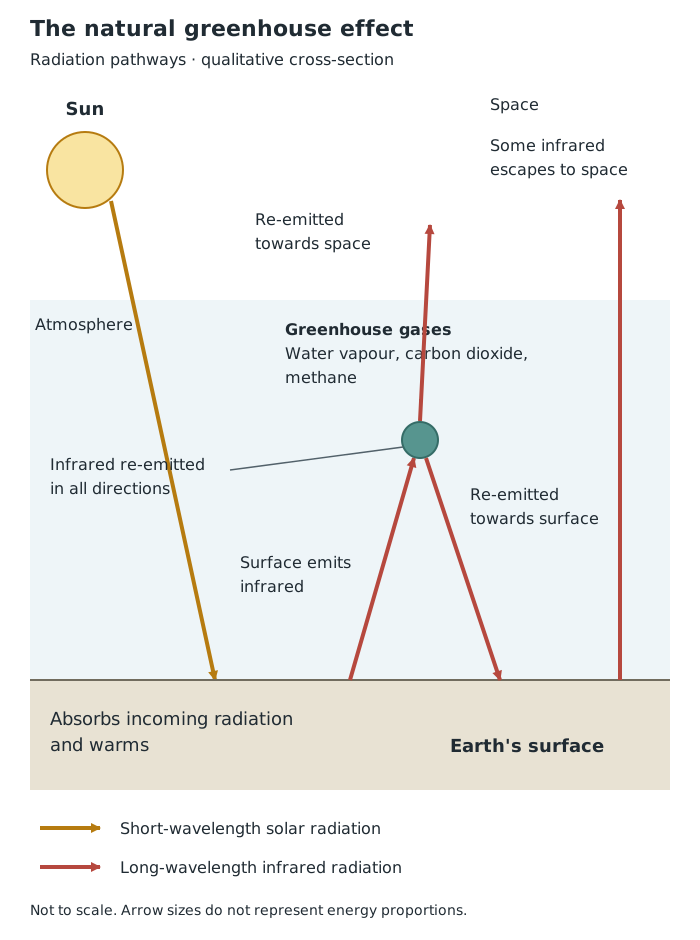
The surface absorbs short-wavelength solar radiation and emits long-wavelength infrared. Greenhouse gases absorb some infrared and re-emit it, including towards the surface.
For example, follow the energy reaching a patch of land: sunlight is absorbed and warms the ground; the ground emits infrared radiation; a greenhouse gas absorbs some of that infrared and re-emits radiation, including towards the ground. This transfers energy back towards the surface rather than allowing it all to escape directly into space.
The overall effect is to reduce the rate of energy loss to space, keeping the surface and lower atmosphere warmer than they would be without greenhouse gases. Some energy still escapes: the atmosphere is not a sealed lid, and energy is not trapped permanently.
The essential sequence is therefore short-wavelength radiation in → absorption by the surface → long-wavelength infrared out → absorption and re-emission by greenhouse gases.
Get unlimited access to all revision notes, key terms, and exam tips.
Distinction: the surface absorbs incoming short-wavelength radiation; greenhouse gases absorb outgoing long-wavelength infrared.
Get unlimited access to all revision notes, key terms, and exam tips.
State which radiation is absorbed by which material: the Earth's surface absorbs incoming short-wavelength radiation; greenhouse gases absorb outgoing long-wavelength infrared radiation.
Use ‘absorb and re-emit’, not ‘reflect’, to describe how greenhouse gases interact with infrared radiation.
Include both short and long wavelengths when describing the greenhouse effect. This requirement applies to both tiers.
Do not confuse the greenhouse effect with the ozone layer: the greenhouse effect reduces energy loss through infrared radiation.
Greenhouse gas
A gas in the atmosphere that absorbs long-wavelength infrared radiation emitted by the Earth's surface. Examples include water vapour, carbon dioxide and methane.
Greenhouse effect
The natural warming of the Earth's surface and atmosphere because greenhouse gases absorb outgoing infrared radiation and re-emit some towards the surface, reducing energy loss to space.
Wavelength
The distance between corresponding points on neighbouring waves, such as from one wave crest to the next.
Infrared radiation
Electromagnetic radiation emitted by warm objects. The Earth's surface emits infrared radiation with longer wavelengths than the incoming solar radiation.
Put your knowledge into practice — try past paper questions for Combined Science Trilogy
Greenhouse gas
A gas in the atmosphere that absorbs long-wavelength infrared radiation emitted by the Earth's surface. Examples include water vapour, carbon dioxide and methane.
Greenhouse effect
The natural warming of the Earth's surface and atmosphere because greenhouse gases absorb outgoing infrared radiation and re-emit some towards the surface, reducing energy loss to space.
Wavelength
The distance between corresponding points on neighbouring waves, such as from one wave crest to the next.
Infrared radiation
Electromagnetic radiation emitted by warm objects. The Earth's surface emits infrared radiation with longer wavelengths than the incoming solar radiation.