Loading…


Loading…
Loading…
Loading…
AQA GCSE Combined Science Trilogy · 8464
AQA 8464 · 4.1.1.4 Check the specification (PDF) (opens in a new tab)
A multicellular organism is made of many cells, but those cells do not all do the same job. An animal needs cells that transmit signals, cells that contract to produce movement and cells that form protective coverings. These different jobs require different cell structures.
Cell differentiation is the process by which a cell changes to become specialised for a particular function. It allows an organism developing from a single fertilised egg to form the many different cell types it needs. These specialised cells can work together in tissues and organs, allowing the whole organism to function.
Cell division and differentiation have different roles in development. Cell division produces more cells; differentiation produces cells suited to different jobs. Increasing cell number alone would not produce all the different cell types an organism needs.
An unspecialised cell has not yet developed the features needed for a particular job. As it differentiates, its shape and the types or amounts of sub-cellular structures it contains change. The resulting specialised cell has a structure suited to its function.
Almost all cells in a multicellular organism contain the same genetic information. However, different genes are switched on in different cell types. This controls how the cells develop, so cells with the same genetic information can acquire different structures and functions.
For example, when an unspecialised cell develops into a nerve cell, its cell membrane and cytoplasm become elongated. This enables the nerve cell to form connections over long distances. The important link is differentiation → a suitable structure → a particular function.
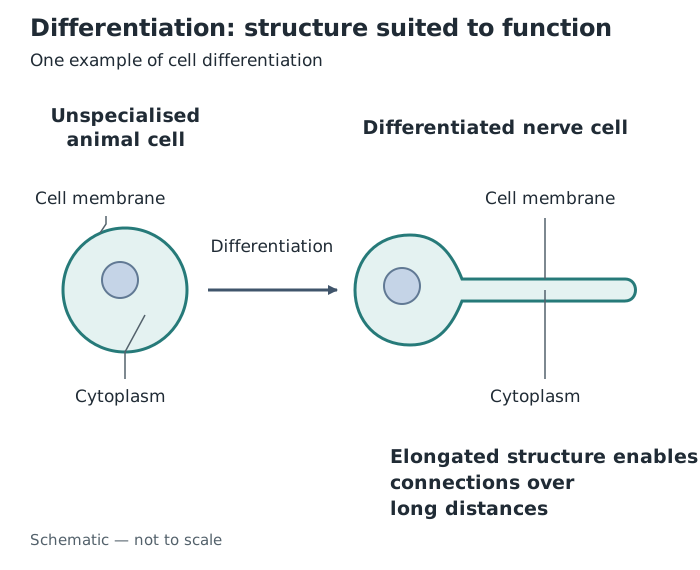
One example of differentiation: changes in cell structure enable a nerve cell to make connections over long distances.
Most types of animal cell differentiate at an early stage of development. As the young animal develops, its cells become specialised to form its different tissues and organs. Most specialised animal cells then lose the ability to differentiate into other cell types.
Some unspecialised cells remain in adult animals and can still differentiate. These provide a source of new specialised cells when tissues need them.
In a mature animal, cell division is mainly restricted to repair and replacement rather than growth. For example, new cells replace worn-out skin cells and help repair damaged tissue after a wound. Division supplies new cells; differentiation allows suitable unspecialised cells to develop the features needed for their role in the tissue.
Many types of plant cell retain the ability to differentiate throughout the plant’s life. This contrasts with the early differentiation of most animal cell types.
Plants therefore continue to produce new specialised cells as they grow and develop. The distinction is not that every plant cell can become any other cell type: it is that many plant cells retain the ability to differentiate, whereas most animal cell types differentiate early.
Get unlimited access to all revision notes, key terms, and exam tips.
Get unlimited access to all revision notes, key terms, and exam tips.
Distinguish cell division, which increases the number of cells, from differentiation, which produces specialised cells.
For the importance of differentiation, link different cell structures to different functions in a multicellular organism.
Keep the qualifiers: most animal cell types differentiate early; many plant cell types retain the ability throughout life. In mature animals, cell division is mainly for repair and replacement.
Cell differentiation
The process by which a cell changes to become specialised, acquiring structures that enable it to carry out a particular function.
Specialised cell
A cell with a structure suited to carrying out a particular function.
Sub-cellular structure
A structure within a cell, such as its nucleus or mitochondria.
Multicellular organism
An organism made of many cells.
Put your knowledge into practice — try past paper questions for Combined Science Trilogy
Cell differentiation
The process by which a cell changes to become specialised, acquiring structures that enable it to carry out a particular function.
Specialised cell
A cell with a structure suited to carrying out a particular function.
Sub-cellular structure
A structure within a cell, such as its nucleus or mitochondria.
Multicellular organism
An organism made of many cells.