Loading…


Loading…
Loading…
Loading…
AQA GCSE Combined Science Trilogy · 8464
AQA 8464 · 5.2.1.4 Check the specification (PDF) (opens in a new tab)
Describe covalent bonds as exceptionally strong bonds uniquely formed when individual atoms actively share pairs of electrons.
Understand that covalently bonded substances may naturally exist as small, simple molecules.
Recognise commonly encountered substances that consist purely of small molecules solely from observing their provided chemical formula.
Recognize that certain covalently bonded substances consist of very large molecules, effectively identifying these as polymers.
Recognize that some specific covalently bonded substances actively form massively scaled giant covalent structures, specifically identifying diamond and silicon dioxide.
Interpret representations of covalent bonds in small molecules and giant structures when shown standard forms like dot and cross diagrams, structural formulae with lines (e.g., H-N-H), and 3D ball and stick models.
Interpret representations of large polymers formatted to show repeating units enclosed in brackets, multiplied by 'n', indicating a vast number of repetitions.
Draw accurate dot and cross diagrams to model the specific molecules of hydrogen, chlorine, oxygen, nitrogen, hydrogen chloride, water, ammonia, and methane.
Represent the specific covalent bonds in small molecules, large polymer repeating units, and vast giant covalent structures strictly by using a distinct single line to represent a single bond.
Describe the fundamental limitations inherently present when using standard dot and cross, ball and stick, and two- or three-dimensional diagrams to represent massive molecules or giant structures.
Deduce the precise molecular formula of a given substance directly from a provided model or standard diagram clearly showing the specific atoms and bonds in the molecule.
Non-metal atoms can bond by sharing electrons. A covalent bond forms when two atoms share a pair of electrons. The negatively charged shared electrons are attracted to the positive nuclei of both atoms, holding the atoms together. Covalent bonds are strong.
The shared electrons count towards the outer shell of both atoms. Hydrogen has one outer electron and needs two for a full outer shell. Carbon, nitrogen, oxygen and chlorine have four, five, six and seven outer electrons respectively; in the molecules considered here, sharing gives each of these atoms eight outer-shell electrons.
For example, two hydrogen atoms each contribute one electron to a shared pair. Each hydrogen then has access to two electrons, forming a hydrogen molecule, H₂. The electrons are shared, not transferred from one atom to the other.
A molecule is a separate group of atoms joined by covalent bonds. Many familiar substances consist of small molecules: hydrogen, H₂; chlorine, Cl₂; oxygen, O₂; nitrogen, N₂; hydrogen chloride, HCl; water, H₂O; ammonia, NH₃; methane, CH₄; and carbon dioxide, CO₂.
The formula tells you the atoms in one molecule. H₂O means two hydrogen atoms and one oxygen atom. NH₃ means one nitrogen atom and three hydrogen atoms. Where there is no subscript, there is one atom of that element.
Recognising familiar formulae helps you identify small molecular substances, but a formula alone does not always reveal the structure. Carbon dioxide, CO₂, consists of small molecules; silicon dioxide, SiO₂, forms a giant covalent network.
A dot and cross diagram shows outer-shell electrons. Dots and crosses distinguish electrons contributed by different atoms; they do not represent different kinds of electron. A shared pair normally contains one electron from each bonded atom. Electrons not used in bonding remain as lone pairs.
To draw a molecule, write the atom symbols and arrange their outer shells so that bonded atoms overlap. Put the shared pairs in the overlaps, then add the remaining outer electrons around their own atoms. Finally, check that each hydrogen has two electrons and each other atom has eight, counting shared electrons for both atoms.
The following patterns cover all eight required molecules. A single bond contains one shared pair, a double bond contains two, and a triple bond contains three.
| Molecule | Shared pairs and arrangement | Lone pairs to include |
|---|---|---|
| Hydrogen, H₂ | One pair between the two H atoms | None |
| Chlorine, Cl₂ | One pair between the two Cl atoms | Three on each Cl |
| Oxygen, O₂ | Two pairs between the two O atoms | Two on each O |
| Nitrogen, N₂ | Three pairs between the two N atoms | One on each N |
| Hydrogen chloride, HCl | One pair between H and Cl | Three on Cl |
| Water, H₂O | Central O shares one pair with each of two H atoms | Two on O |
| Ammonia, NH₃ | Central N shares one pair with each of three H atoms | One on N |
| Methane, CH₄ | Central C shares one pair with each of four H atoms | None |
For water, oxygen supplies one electron to each of its two bonds. Four of its original six outer electrons remain unshared, forming two lone pairs. For oxygen gas, each oxygen supplies two electrons to the double bond, leaving four unshared electrons on each atom.
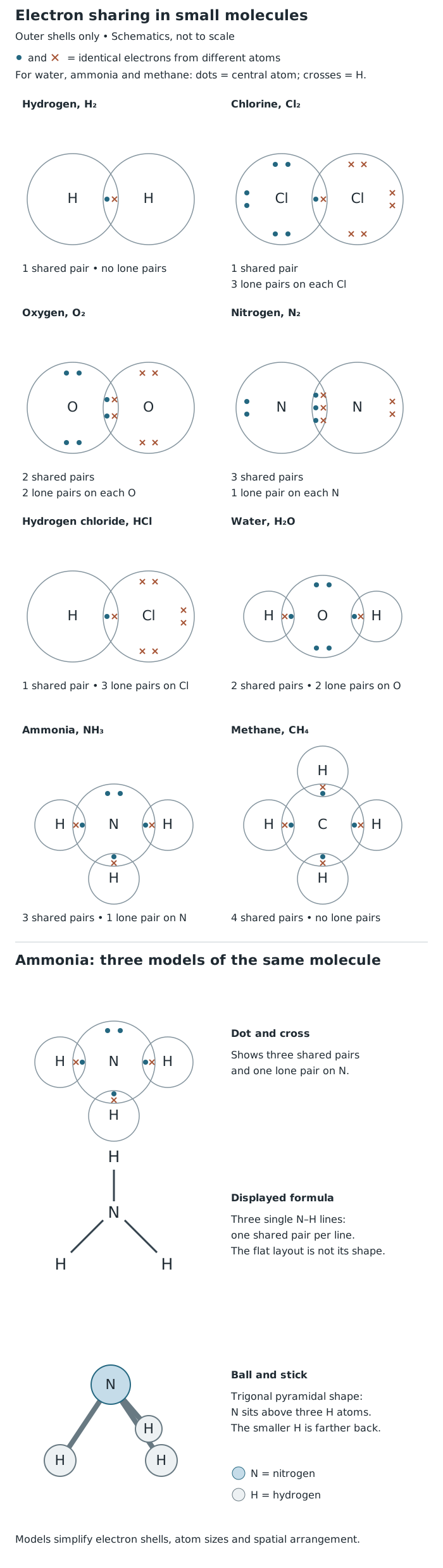
Shared pairs lie between bonded atoms; lone pairs remain on their own atoms. Different ammonia models show electrons, connections or three-dimensional arrangement.
In a structural formula, each line represents a single covalent bond: one shared pair of electrons. Hydrogen can be shown as H–H and water as H–O–H. Ammonia has three N–H lines around a central nitrogen; methane has four C–H lines around a central carbon. Two lines represent the double bond in O₂, and three represent the triple bond in N₂.
A ball and stick model uses balls for atoms and sticks for bonds. Use the labels or colour key to identify the elements. It helps show the three-dimensional arrangement: ammonia has three hydrogen atoms arranged around a nitrogen atom in a pyramid, rather than all four atoms lying in one plane.
These representations describe the same bonding but emphasise different features. Dot and cross diagrams show shared and unshared electrons; structural formulae show connections clearly; ball and stick models show spatial arrangement.
Not all molecules are small. A polymer contains very large molecules made from a repeating group of atoms joined together many times by covalent bonds.
Poly(ethene) has the repeating unit –CH₂–CH₂–. Its representation places this unit inside brackets, with a subscript outside. Here, means a large number of repetitions; it is not an atom or an element symbol.
Each carbon in this repeating unit has single bonds to two hydrogen atoms and two neighbouring carbon atoms. The carbon–carbon bonds extend through the brackets to show that the chain continues into the next repeating unit. When drawing the unit, include those continuing bonds rather than leaving the carbon atoms at the ends unconnected.
Some substances form a giant covalent structure rather than separate molecules. Strong covalent bonds join atoms into a continuous network extending throughout the structure.
Diamond is a giant covalent structure made only of carbon. Each carbon atom is bonded to four other carbon atoms in a three-dimensional network.
Silicon dioxide is also giant covalent. Each silicon atom is bonded to four oxygen atoms, and each oxygen atom links two silicon atoms. SiO₂ gives the overall ratio of silicon to oxygen atoms; it does not describe a separate three-atom molecule.
To represent part of either structure, draw labelled atoms joined by single lines. The drawing shows only a small fragment: bonds at its boundary continue into the rest of the network. A polymer chain is a very large molecule, whereas diamond and silicon dioxide are continuous networks rather than collections of separate chains.
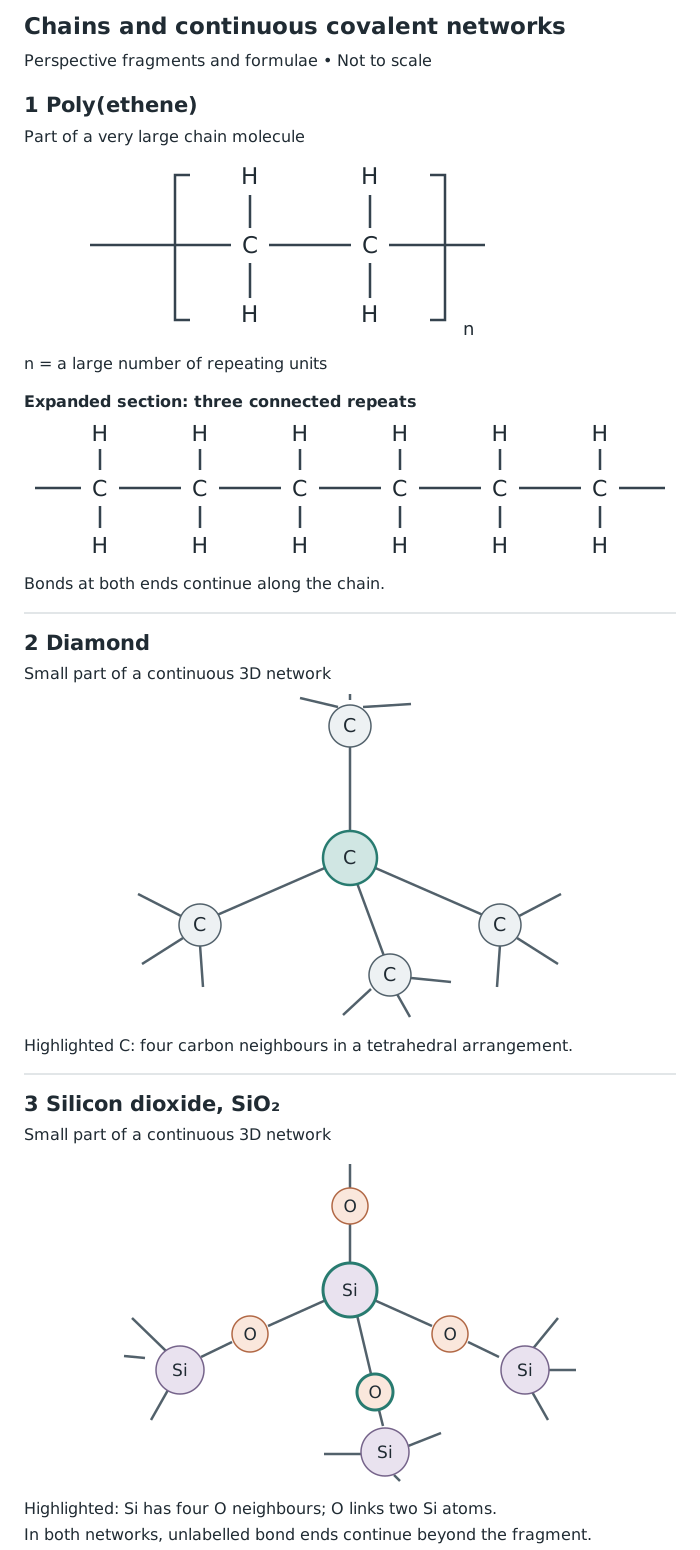
Poly(ethene) repeats along a chain. Diamond and silicon dioxide extend as giant covalent networks; each drawing shows only a small part.
First identify each element using the atom symbols or the model's key. Then count every atom of each element in one complete molecule and write those counts as subscripts. Leave out the subscript 1.
For example, ethane has two carbon atoms joined by a single bond, with three hydrogen atoms attached to each carbon. Counting gives two carbon atoms and six hydrogen atoms, so its molecular formula is C₂H₆. The three-dimensional position of an atom does not change the count: a hydrogen behind another atom still belongs to the molecule.
This method needs a complete molecule. A fragment of a giant network or a polymer repeating unit does not show all the atoms of a complete molecule.
All models simplify the real structure. Dot and cross diagrams show electron sharing but not the true three-dimensional arrangement or relative atom sizes. Dots and crosses also do not show electrons moving.
Two-dimensional structural formulae show which atoms are connected, but their flat layout does not usually show the real molecular shape. Lines are symbols for bonds, not physical rods.
Three-dimensional ball and stick models make shape clearer, but atoms are not hard balls separated by the large empty gaps suggested by the sticks. These models usually omit electrons and are not accurate scale drawings.
For polymers and giant structures, a further limitation is size: a practical drawing or model shows only a short chain or a small section of a network. Brackets, continuing bonds and explanations are needed to show how that section relates to the much larger structure.
Get unlimited access to all revision notes, key terms, and exam tips.
| Molecule | Bonds | Lone pairs |
|---|---|---|
| H₂ | One single | None |
| Cl₂ | One single | Three per Cl |
| O₂ | One double | Two per O |
| N₂ | One triple | One per N |
| HCl | One single | Three on Cl |
| H₂O | Two O–H | Two on O |
| NH₃ | Three N–H | One on N |
| CH₄ | Four C–H | None |
Dot and cross: no true 3D shape or relative sizes. Flat diagrams: connections, not true spatial arrangement. Ball and stick: unrealistic gaps, no electrons. Giant-structure and polymer models: only a small section is shown.
Get unlimited access to all revision notes, key terms, and exam tips.
In a dot and cross diagram, place each shared pair in the overlap between the atoms and include all non-bonding outer electrons.
Hydrogen needs two electrons in its full outer shell; the other atoms in these eight molecules need eight. Count shared electrons for both bonded atoms.
One line represents one shared pair. Oxygen has a double bond; nitrogen has a triple bond.
To deduce a molecular formula, count the actual atoms in one molecule. Do not simplify their ratio: C₂H₆ is not CH₃.
A similar-looking formula does not guarantee a similar structure: CO₂ consists of small molecules, whereas SiO₂ is giant covalent.
Covalent bond
A strong bond between atoms formed by sharing a pair of electrons.
Molecule
A discrete group of atoms joined together by covalent bonds.
Lone pair
A pair of outer-shell electrons that is not shared in a covalent bond.
Polymer
A substance made of very large molecules containing many repeating units joined by covalent bonds.
Repeating unit
The group of atoms that occurs repeatedly along a polymer molecule.
Giant covalent structure
A continuous network of a very large number of atoms joined by covalent bonds, rather than separate small molecules.
Molecular formula
A formula showing the actual number of atoms of each element in one molecule.
Put your knowledge into practice — try past paper questions for Combined Science Trilogy
Covalent bond
A strong bond between atoms formed by sharing a pair of electrons.
Molecule
A discrete group of atoms joined together by covalent bonds.
Lone pair
A pair of outer-shell electrons that is not shared in a covalent bond.
Polymer
A substance made of very large molecules containing many repeating units joined by covalent bonds.
Repeating unit
The group of atoms that occurs repeatedly along a polymer molecule.
Giant covalent structure
A continuous network of a very large number of atoms joined by covalent bonds, rather than separate small molecules.
Molecular formula
A formula showing the actual number of atoms of each element in one molecule.