Loading…


Loading…
Loading…
Loading…
AQA GCSE Combined Science Trilogy · 8464
AQA 8464 · 5.1.1.1 Atoms, Elements, and Compounds Check the specification (PDF) (opens in a new tab)
Understand that all substances are fundamentally made of atoms and describe an atom as the smallest part of an element that can exist.
Recognise that atoms of each element are universally represented by a specific chemical symbol, such as O for oxygen or Na for sodium.
Recall that there are approximately 100 different chemical elements, all of which are categorised and displayed in the periodic table.
Describe compounds as substances newly formed from elements via chemical reactions, noting that these reactions always involve the formation of one or more new substances and often involve a detectable energy change.
Explain that compounds contain two or more different elements chemically combined in fixed, defined proportions.
Represent compounds using precise chemical formulae that incorporate the symbols of the atoms from which they were formed.
Understand that compounds can only be separated back into their constituent elements through chemical reactions.
Represent chemical reactions accurately using clear word equations or balanced symbol equations.
Use the standard names and chemical symbols of the first 20 elements in the periodic table, the elements in Groups 1 and 7, and other specifically noted elements.
Name specific compounds of these elements when provided with a formula or a balanced symbol equation.
Write correct word equations, formulate correct chemical formulae, and construct balanced chemical equations for specified reactions.
Write accurately balanced half-equations and ionic equations where appropriate (Higher Tier only).
All substances are made of atoms. An atom is the smallest part of an element that can exist. An element is a substance containing only one type of atom: a sample of sodium contains sodium atoms, while a sample of oxygen contains oxygen atoms.
There are about 100 different elements, displayed in the periodic table. These elements provide the building blocks for a much larger range of substances because atoms of different elements can chemically combine.
Each element has a chemical symbol. O represents oxygen and can represent one oxygen atom; Na represents sodium and can represent one sodium atom. Some symbols resemble the English name, while others do not, so you need to recognise the name–symbol pairs rather than guess them.
The first letter is always a capital. If there is a second letter, it is lower case. For example, Co means cobalt, whereas CO is a formula containing carbon, C, and oxygen, O.
You will be supplied with a periodic table in the exam. Being comfortable with it means you can move between an element's name and its symbol when reading or naming a compound.
The first 20 elements, in periodic-table order, are:
| Position | Element | Symbol | Position | Element | Symbol |
|---|---|---|---|---|---|
| 1 | Hydrogen | H | 11 | Sodium | Na |
| 2 | Helium | He | 12 | Magnesium | Mg |
| 3 | Lithium | Li | 13 | Aluminium | Al |
| 4 | Beryllium | Be | 14 | Silicon | Si |
| 5 | Boron | B | 15 | Phosphorus | P |
| 6 | Carbon | C | 16 | Sulfur | S |
| 7 | Nitrogen | N | 17 | Chlorine | Cl |
| 8 | Oxygen | O | 18 | Argon | Ar |
| 9 | Fluorine | F | 19 | Potassium | K |
| 10 | Neon | Ne | 20 | Calcium | Ca |
A group is a vertical column in the periodic table. Using the GCSE group numbering:
Hydrogen, H, is often shown above Group 1, but it is not a Group 1 metal.
Other useful name–symbol pairs encountered in GCSE chemistry include iron, Fe; copper, Cu; zinc, Zn; silver, Ag; gold, Au; and lead, Pb. Use the supplied periodic table to check other elements when they appear in a question.
A compound contains two or more different elements chemically combined in fixed proportions. Compounds are formed from elements by chemical reactions.
A chemical reaction always produces one or more new substances. It often also produces a detectable energy change, such as a temperature change. The formation of a new substance is the essential distinction: heating or mixing substances does not necessarily mean that a chemical reaction has occurred.
The new compound usually has properties quite different from those of its constituent elements. Sodium and chlorine, for example, combine to form sodium chloride, the compound commonly called salt. Sodium chloride is a new substance, not simply sodium and chlorine placed side by side.
In a mixture, substances are not chemically combined. By contrast, separating a compound into its elements requires a chemical reaction. Physical separation methods such as filtration cannot undo the chemical combination.
A chemical formula uses element symbols to show which elements are present and the relative numbers of their atoms. A small number written below and to the right of a symbol is called a subscript. It gives the number of atoms of that element. If there is no subscript, the number is one.
For compounds made of molecules, the formula gives the atoms in each molecule:
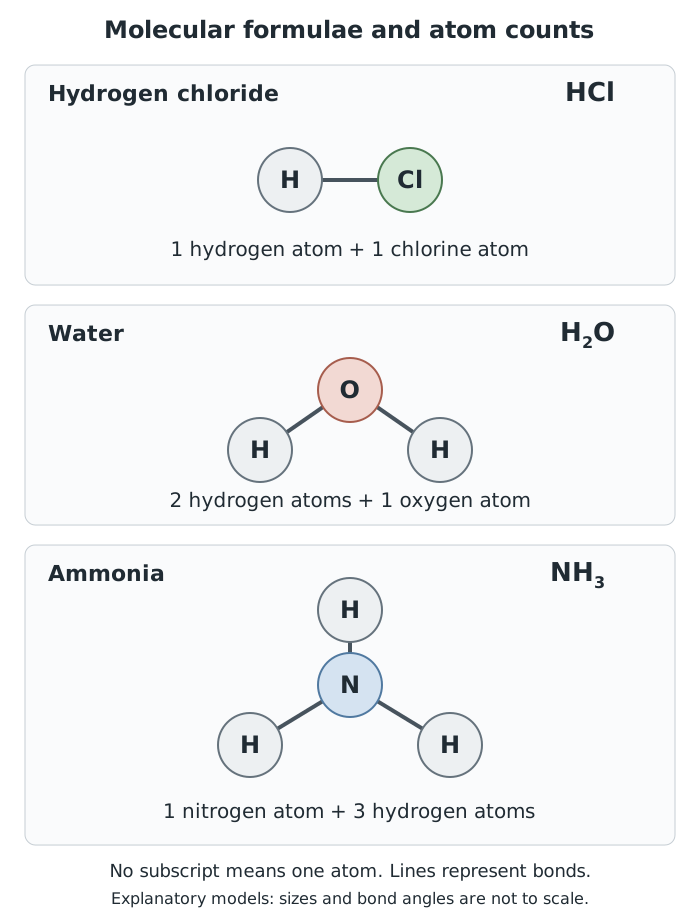
A molecular formula gives the number of atoms of each element in one molecule. No subscript means one atom.
The proportions are fixed. Every water molecule has two hydrogen atoms for each oxygen atom. A larger sample contains more molecules, but the hydrogen-to-oxygen ratio remains 2 : 1.
Not every compound consists of separate molecules. For compounds such as sodium chloride, NaCl, the formula shows the simplest ratio of the elements: one sodium for each chlorine. You can read this ratio without needing to describe the compound as a molecule.
Some formulae contain brackets. In Ca(OH)₂, the subscript 2 applies to the whole OH group, so the formula contains one calcium, two oxygen and two hydrogen atoms. In Na₂CO₃, there are two sodium, one carbon and three oxygen atoms.
First identify the element symbols. Then use the appropriate naming pattern or familiar compound name.
For many compounds containing a metal and one non-metal, name the metal first and change the non-metal ending to -ide:
| Formula | Elements present | Compound name |
|---|---|---|
| NaCl | Sodium and chlorine | Sodium chloride |
| MgCl₂ | Magnesium and chlorine | Magnesium chloride |
| CuO | Copper and oxygen | Copper oxide |
| PbS | Lead and sulfur | Lead sulfide |
A compound's name does not always state the number of atoms. Magnesium chloride is MgCl₂, even though the name does not include ‘two’. The formula gives the proportions.
For some compounds of non-metals, prefixes indicate numbers of atoms. CO₂ is carbon dioxide: ‘di-’ indicates two oxygen atoms. CO is carbon monoxide: ‘mono-’ indicates one oxygen atom. These are different compounds, so reading the subscript matters.
Names ending in -ate often indicate an oxygen-containing compound. Useful examples are Na₂CO₃, sodium carbonate; NaNO₃, sodium nitrate; and CuSO₄, copper sulfate. The ending alone does not tell you the number of oxygen atoms: read that from the formula.
Some compounds have familiar names that you need to recognise directly:
| Formula | Name |
|---|---|
| H₂O | Water |
| NH₃ | Ammonia |
| CH₄ | Methane |
| HCl dissolved in water | Hydrochloric acid |
| H₂SO₄ | Sulfuric acid |
| HNO₃ | Nitric acid |
| C₂H₅OH | Ethanol |
The same naming approach works when a formula appears within a symbol equation. Identify each formula as a substance in its own right: MgCl₂ still means magnesium chloride wherever it appears in the equation.
Chemical symbols are case-sensitive: write Na, not NA or na. Cl is chlorine; C is carbon.
A compound must contain at least two different elements. Having several atoms does not, by itself, make a substance a compound.
A subscript applies to the symbol immediately before it; a subscript outside brackets applies to everything inside those brackets.
Do not describe compounds as impure. A pure substance can be either an element or a compound.
Use the periodic table supplied in the exam to check unfamiliar names and symbols.
Distinguish hydrogen chloride from hydrochloric acid: HCl gas is hydrogen chloride; its aqueous solution is hydrochloric acid.
Atom
The smallest part of an element that can exist. All substances are made of atoms.
Element
A substance containing only one type of atom.
Chemical symbol
A one- or two-letter representation of an element, such as O for oxygen or Na for sodium. It can also represent one atom of that element.
Periodic table
A table displaying the chemical elements in an organised arrangement.
Compound
A substance containing two or more different elements chemically combined in fixed proportions.
Chemical formula
A representation using chemical symbols and numbers to show which elements a substance contains and the relative numbers of their atoms.
Molecule
A group of atoms chemically bonded together.
Chemical reaction
A process in which one or more new substances are formed, often with a detectable energy change.
Put your knowledge into practice — try past paper questions for Combined Science Trilogy
Atom
The smallest part of an element that can exist. All substances are made of atoms.
Element
A substance containing only one type of atom.
Chemical symbol
A one- or two-letter representation of an element, such as O for oxygen or Na for sodium. It can also represent one atom of that element.
Periodic table
A table displaying the chemical elements in an organised arrangement.
Compound
A substance containing two or more different elements chemically combined in fixed proportions.
Chemical formula
A representation using chemical symbols and numbers to show which elements a substance contains and the relative numbers of their atoms.
Molecule
A group of atoms chemically bonded together.
Chemical reaction
A process in which one or more new substances are formed, often with a detectable energy change.