

Loading…
Loading…
Loading…
AQA GCSE Citizenship Studies · 8100
AQA 8100 Check the specification (PDF) (opens in a new tab)
A government decision does not put itself into practice. Policies need staff to develop the details, organise resources and provide services to the public. is this practical and organisational work. For example, paying pensions and issuing driving licences require systems that turn government decisions into everyday services.
Ministers provide political leadership, while the Civil Service carries out much of the continuing work of government. Understanding administration means distinguishing who directs policy from who advises on it and puts it into effect.
A government department is responsible for a particular area of government activity. The Department for Transport, for example, deals with transport. Dividing administration into departments allows staff to concentrate their knowledge and work on particular responsibilities.
Most departments are led by ministers, who are responsible for their departments’ actions, successes and failures. Civil servants support them with advice and practical work. A ministry is a name used for some departments: the Ministry of Defence is a government department, not an extra level above or below one.
Departments do not all have the same geographical responsibilities. The Ministry of Defence covers the whole UK, whereas the Department for Work and Pensions does not cover Northern Ireland. This reflects devolution: some responsibilities belong to governments in Scotland, Wales and Northern Ireland rather than to UK government departments.
There are also non-ministerial departments, led by senior civil servants rather than ministers. These usually carry out regulatory or inspection work. The Charity Commission is an example.
An executive agency is part of a government department and usually focuses on delivering a service. The overseeing department decides policy; the agency concentrates on putting it into operation.
For example, the Driver and Vehicle Licensing Agency (DVLA) is an executive agency overseen by the Department for Transport. Issuing driving licences is part of its practical service-delivery work. The department and agency are therefore connected organisations with different roles, not competing governments.
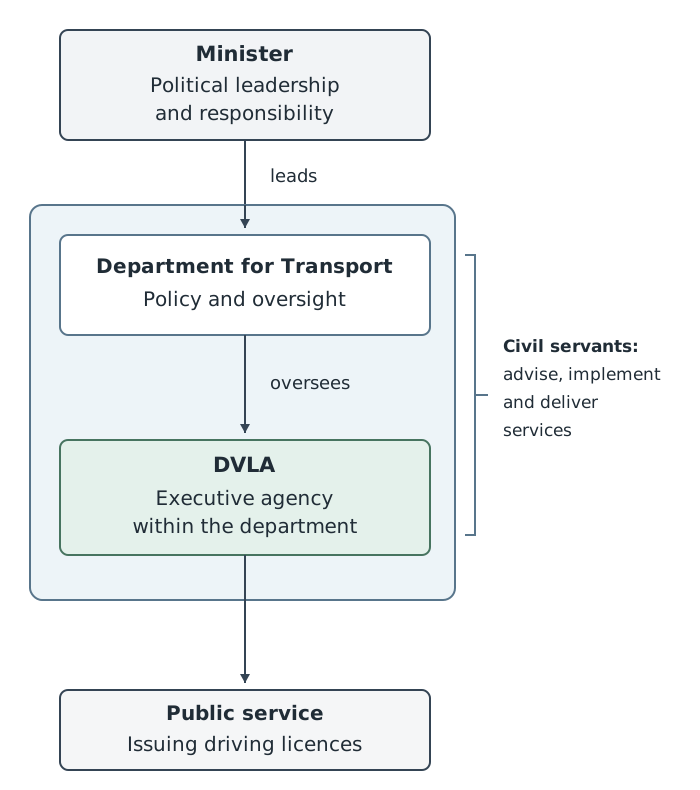
The department oversees policy and its executive agency delivers a specialised service. Civil servants support both policy work and delivery.
Not every public body is an executive agency. Other public bodies can have varying degrees of independence from departments. The Environment Agency, for example, is an executive non-departmental public body, rather than an executive agency within a department.
The Civil Service supports the government of the day in developing and implementing policy and delivering services. Its staff work in departments, agencies and some other government bodies. The most senior civil servant in a department is its permanent secretary.
Some civil servants work on policy: analysts examine evidence, lawyers advise on legal issues, and project managers organise implementation. Others provide services directly, including paying benefits and pensions, running employment services, staffing prisons and issuing driving licences. Civil servants therefore do more than office paperwork.
Ministers are politically appointed; civil servants are generally appointed on merit through fair and open competition. Civil servants are normally accountable to ministers, who in turn are accountable to Parliament. This connects the work of administration to political responsibility.
The Civil Service is not the same as the whole public sector. NHS employees, members of the armed forces, police officers and local government officers are not civil servants.
Civil servants must serve governments of different political parties equally well. This political impartiality allows a new government to receive professional support rather than an administration working against it because of staff members’ personal beliefs.
Neutrality does not mean having no political opinions. It means not allowing those opinions to determine official advice or actions, and not using official resources for party-political purposes. Civil servants must also follow the restrictions that apply to their political activities.
The Civil Service Code sets out four core values:
For example, a civil servant advising a minister must present relevant evidence, including inconvenient facts, rather than select only facts that support the minister’s preferred option. Once a decision has been taken, civil servants must not obstruct its implementation simply because they disagree with it. They must also comply with the law. Their role combines honest advice with professional implementation, not unquestioning agreement or party loyalty.
Use a named example to explain the structure: the Driver and Vehicle Licensing Agency (DVLA) is an executive agency of the Department for Transport.
Distinguish political responsibility from administrative work: ministers direct policy and answer to Parliament; civil servants advise and implement.
Political impartiality does not mean refusing to carry out government policy. Explain that civil servants serve governments of different parties equally well.
Do not describe every public-sector worker as a civil servant: NHS employees, police officers and local government officers are not part of the Civil Service.
It can see this note and what your specification asks for.
Answers are free with an account.
1 free note left this week
Get more free notesYour answer sets when this note comes back for review, or marks it complete.
Was this note helpful?
Log in to tell us whether it helped, or to report a problem.
Last updated
Government administration
The practical organisation and work needed to put government decisions into effect and deliver public services.
Government department
An organisation responsible for a particular area of government work, such as transport or defence. Most are led by ministers.
Ministry
A name used for some government departments, such as the Ministry of Defence; it is not a separate level of government.
Executive agency
An organisation within a government department that usually delivers a particular service rather than deciding policy.
Civil Service
The body of government staff who support the government of the day by advising on policy, implementing decisions and delivering public services.
Permanent secretary
The most senior civil servant in a government department.
Political impartiality
Serving governments of different political parties equally well, without allowing personal political beliefs to determine official advice or actions.
Objectivity
Basing advice and decisions on careful analysis of evidence rather than personal preferences.
Put your knowledge into practice — try past paper questions for Citizenship Studies
Government administration
The practical organisation and work needed to put government decisions into effect and deliver public services.
Government department
An organisation responsible for a particular area of government work, such as transport or defence. Most are led by ministers.
Ministry
A name used for some government departments, such as the Ministry of Defence; it is not a separate level of government.
Executive agency
An organisation within a government department that usually delivers a particular service rather than deciding policy.
Civil Service
The body of government staff who support the government of the day by advising on policy, implementing decisions and delivering public services.
Permanent secretary
The most senior civil servant in a government department.
Political impartiality
Serving governments of different political parties equally well, without allowing personal political beliefs to determine official advice or actions.
Objectivity
Basing advice and decisions on careful analysis of evidence rather than personal preferences.