

Loading…
Loading…
Loading…
AQA GCSE Citizenship Studies · 8100
AQA 8100 Check the specification (PDF) (opens in a new tab)
The United Kingdom contains England, Scotland, Wales and Northern Ireland. Although the UK Parliament at Westminster makes decisions for the UK, not every decision is made there. transfers powers and responsibilities to institutions governing particular nations or regions within the UK.
The purpose is to allow decisions and services to be shaped closer to the people they affect. Different places can have different needs and political priorities, so devolved government allows different approaches within the same country. Devolution is not independence: the nations remain within the UK, and the UK Parliament retains authority to make laws.
Scotland, Wales and Northern Ireland each have a devolved legislature and a devolved government. England has a different arrangement, with regional institutions in parts of the country rather than a separate parliament for England.
In September 1997, voters in Scotland and Wales supported establishing devolved institutions in referendums. In Northern Ireland, devolution formed part of the Good Friday Agreement, also known as the Belfast Agreement, which voters supported in May 1998.
The UK Parliament then passed the Scotland Act 1998, Government of Wales Act 1998 and Northern Ireland Act 1998. The new institutions began exercising devolved responsibilities in 1999. These arrangements were not identical: each reflected the nation's history and existing structures.
A legislature debates and makes laws and examines what the government is doing. Its elected representatives provide a way for citizens' views to be represented in decisions.
An executive, or government, directs policy and oversees its implementation. Ministers take responsibility for particular areas of government, supported by departments and civil servants. In the devolved nations, ministers are drawn from the elected legislature. Their civil servants serve those devolved ministers, not the UK Prime Minister.
This distinction matters: a parliament or assembly is not simply another name for the government. Representatives can question ministers and scrutinise their decisions, while ministers are responsible for running the devolved administration.
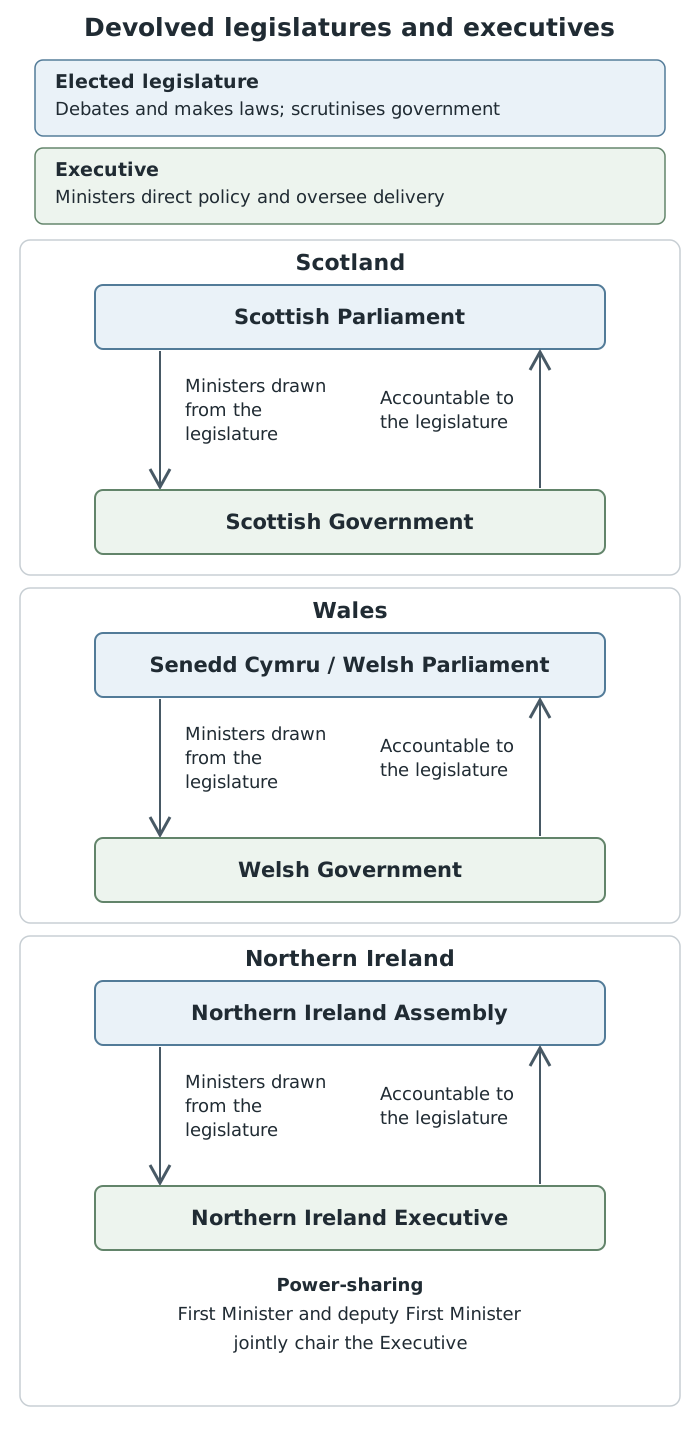
Each devolved nation has an elected legislature and a distinct executive. Northern Ireland's executive uses a power-sharing arrangement.
Scotland's elected legislature is the Scottish Parliament. Its executive is the Scottish Government. The Parliament debates and makes laws within its devolved responsibilities and scrutinises the Government; ministers in the Scottish Government develop policy and oversee its delivery.
Wales has the Senedd Cymru, also called the Welsh Parliament. It was originally established as the National Assembly for Wales. The executive is the Welsh Government. Here too, the elected legislature and the government have distinct roles: the Senedd makes laws and examines government action, while Welsh ministers lead the administration.
Both nations therefore have their own democratic institutions alongside the UK Parliament and UK Government. Devolution allows their governments to pursue their own political priorities within their responsibilities.
Northern Ireland's legislature is the Northern Ireland Assembly, with 90 elected representatives called Members of the Legislative Assembly, or MLAs. They debate and pass laws on devolved matters and examine the work of the executive.
The Northern Ireland Executive runs the devolved government. Unlike a government formed solely by one governing party, its organisation is based on power-sharing between parties represented in the Assembly. This reflects the Good Friday Agreement's approach to governing a society with different political traditions.
The First Minister and deputy First Minister jointly chair the Executive. Despite their different titles, this is a joint leadership arrangement, not simply a leader and an ordinary deputy. There are also eight other ministers responsible for government departments.
Seven of these ministerial posts are allocated to parties through a procedure called d’Hondt, which links a party's entitlement to posts to its representation in the Assembly. The Justice Minister is appointed through a cross-community vote in the Assembly. These arrangements help ensure that government is shared rather than controlled entirely by a single political tradition.
England does not have a separate England-wide devolved parliament and government equivalent to those in Scotland or Wales. The UK Parliament and UK Government continue to make decisions for England, including on matters handled by devolved institutions elsewhere in the UK.
However, some powers and budgets have been devolved to regional bodies within England. Combined authorities bring together groups of local councils to make decisions across a wider area. Many are led by a directly elected regional mayor, also known as a metro mayor. These mayor-led bodies are also known as mayoral strategic authorities.
Examples include Greater Manchester, the West Midlands and Liverpool City Region. Their responsibilities typically include aspects of transport, skills, housing and infrastructure investment, although the precise powers vary between places. A regional approach makes sense where an issue crosses council boundaries: transport connections, for example, need to work across a whole city region rather than stop at each council's boundary.
The mayor provides visible regional leadership and chairs the authority. Direct election allows residents to choose who holds that leadership role and to hold the mayor accountable at elections. London also has a directly elected mayor, but its devolution model differs from that of combined authorities.
The essential contrast is therefore between devolved national legislatures and governments in Scotland, Wales and Northern Ireland, and varied regional arrangements within England.
Devolution: powers and responsibilities transferred to institutions within the UK—not independence.
Legislature: makes laws and scrutinises government. Executive: ministers who direct policy and oversee its delivery.
| Nation | Legislature | Executive |
|---|---|---|
| Scotland | Scottish Parliament | Scottish Government |
| Wales | Senedd Cymru / Welsh Parliament | Welsh Government |
| Northern Ireland | Northern Ireland Assembly | Northern Ireland Executive |
1997: Scottish and Welsh referendums. 1998: Good Friday Agreement referendum and three devolution Acts. 1999: institutions began exercising devolved responsibilities.
Distinguish the elected legislature from the government: the Scottish Parliament is not the same institution as the Scottish Government.
Cover England as well as Scotland, Wales and Northern Ireland. England has regional devolution, but no separate England-wide devolved parliament.
Do not describe devolution as independence: Scotland, Wales and Northern Ireland remain parts of the UK.
Use named examples, such as the Northern Ireland Assembly or the Greater Manchester combined authority, rather than referring only to ‘regional government’.
It can see this note and what your specification asks for.
Answers are free with an account.
1 free note left this week
Get more free notesYour answer sets when this note comes back for review, or marks it complete.
Was this note helpful?
Log in to tell us whether it helped, or to report a problem.
Last updated
Devolution
The transfer of powers and responsibilities from central government to institutions governing a nation or region within the same state.
Legislature
A body that debates and makes laws and examines the work of government.
Executive
The part of government made up of ministers who direct policy and oversee its implementation through government departments.
Regional government
Government operating across a region, between the level of individual local councils and central government.
Combined authority
An authority bringing together a group of local councils to carry out agreed functions across a wider area.
Regional mayor
A directly elected leader of an English regional authority with devolved functions and budgets; also called a metro mayor.
Power-sharing
An arrangement in which political parties share responsibility for government, rather than one party governing alone.
Put your knowledge into practice — try past paper questions for Citizenship Studies
Devolution
The transfer of powers and responsibilities from central government to institutions governing a nation or region within the same state.
Legislature
A body that debates and makes laws and examines the work of government.
Executive
The part of government made up of ministers who direct policy and oversee its implementation through government departments.
Regional government
Government operating across a region, between the level of individual local councils and central government.
Combined authority
An authority bringing together a group of local councils to carry out agreed functions across a wider area.
Regional mayor
A directly elected leader of an English regional authority with devolved functions and budgets; also called a metro mayor.
Power-sharing
An arrangement in which political parties share responsibility for government, rather than one party governing alone.